
Exhaustion Gap: Definition, Types & How to Trade It
- Updated on :
- 984 Views
- by Manaswi Agarwal

 Instagram
 Linkedin
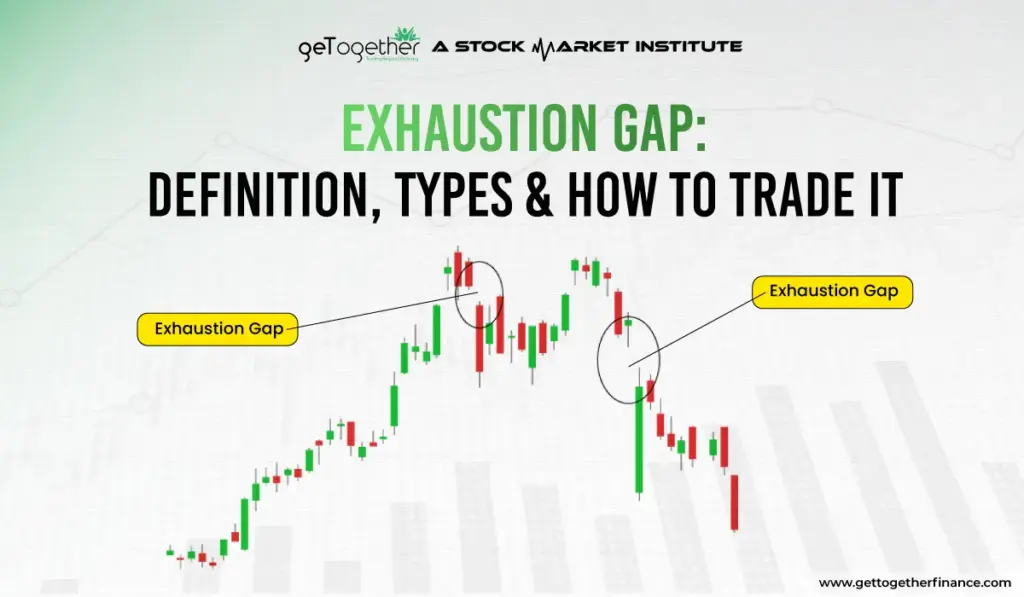
In trading, exhaustion gaps matter because they assist traders in identifying potential trend reversals. Generally, these gaps appear after a big up or down move. Also, it indicates that the current trend fades because buyers and sellers are heavily active in the market. Exhaustion gaps are different from ordinary price gaps because they are supported by a sudden increase in trading volume. Also, they signal that the current price trend is about to reverse.
In this blog, you will learn about exhaustion gaps, their different types, and how to spot bullish and bearish exhaustion gaps. Beyond this, it covers how traders combine these gaps with supply and demand zones to trade more confidently and manage their risk wisely.
What is an Exhaustion Gaps?

A gap theory simply states the difference between the opening price of the current trading session with that of the closing price of the previous trading session. The occurrence of an exhaustion gap signified the reversal in the trend as the price opens with a gap in a contrast direction of the trend. It is one significant technical pattern that is used by traders, which is characterized by a gap in price accompanied by higher trading volume and the culmination of sustained price movement. As a technical indicator, exhaustion gap determines an imminent reversal in the prevailing market direction which recommends traders about a pivotal shift within the market security.
The principle on which the exhaustion gap relies is a potential decrease in the number of buyers where sellers have aggressively stepped into the market warns traders about a stop in the upward trend.
In short, the definition of an exhaustion gaps is defined as a chart pattern that develops near the end of a strong trend. This pattern forms when the market opens sharply against the existing trend direction, and it is supported by strong trading volume. This signals that the trend is losing its strength and a reversal is around the corner.
Types of Exhaustion Gap
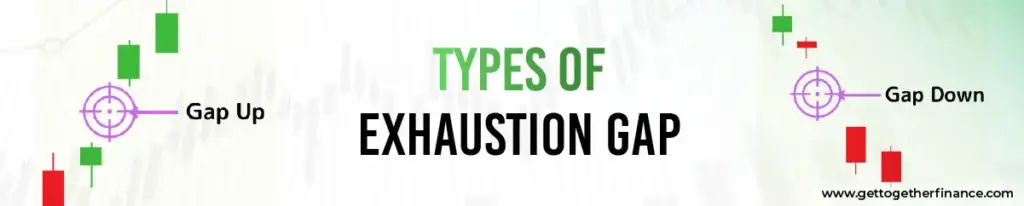
Exhaustion gaps are mainly categorised into two types based on the current trend direction and predicted move in the market. Through this gap, the trader can figure out whether the buying or selling force in the market is running out of steam.
1. Bearish Exhaustion Gap
When the market has been rising strongly, but buyers start losing their energy, a bearish exhaustion gap occurs. The stock opens higher than the previous closing price, but instead of continuing to rise, it suddenly starts declining. This mainly happens when a lot of traders are buying and selling at the same time. Also, it signals that sellers are taking over and the uptrend is about to end. Traders mainly use bearish exhaustion gaps to find the right moment to sell.
2. Bullish Exhaustion Gap
When the market has been falling strongly, but sellers strongly push the price down, a bullish exhaustion gap occurs. The stock opens lower than the previous closing price, but instead of continuing to fall, it suddenly starts rising. This mainly happens when there is a sudden increase in buying and selling activity at the same time. Also, it signals that buyers are taking over and the downtrend is about to end. Traders mainly use bullish exhaustion gaps to find the best moment to buy before the market starts rising.
How to Identify an Exhaustion Gap: 3 Key Signs
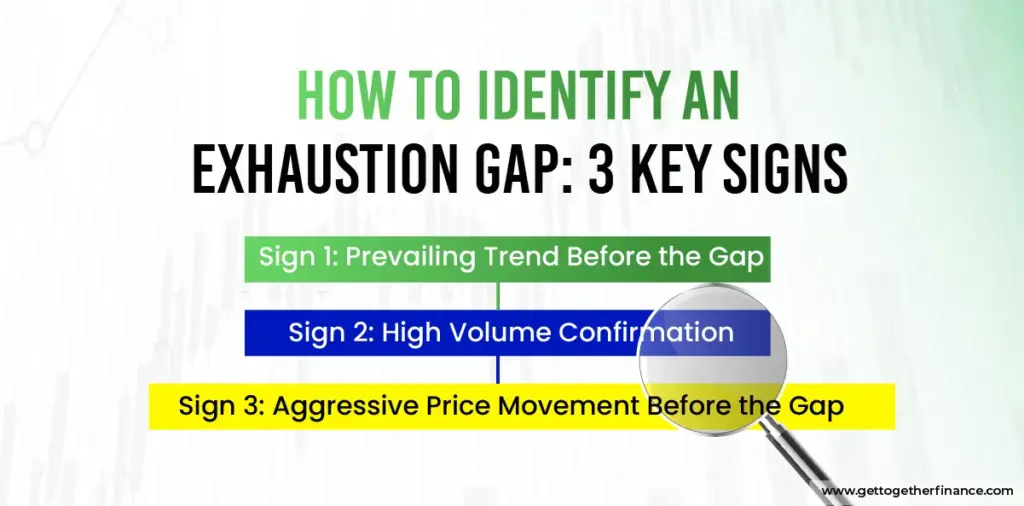
For a trader, it is crucial to identify an exhaustion gap correctly because they can detect early trend reversals and protect themselves from misleading trading signals. When the market goes up and down, these gaps appear, and you can verify them by seeing how volume and price react afterward.
Sign 1: Prevailing Trend Before the Gap
When the market strongly moves in one direction for a long time, like days, weeks, or even months, then the exhaustion gap forms. The strong rise or fall in the market shows that buyers or sellers are very actively involved. A gap can only be called an exhaustion gap if there was a strong trend before it.
Sign 2: High Volume Confirmation
The most crucial confirmation of an exhaustion gap is high trading volume. Once this gap appears, traders buy and sell more aggressively than usual. When volume suddenly increases, it signals that many traders have jumped into the market and a reversal is around the corner.
Sign 3: Aggressive Price Movement Before the Gap
Before the gap appeared, the stock was moving in one direction. In a rising market, buyers buy a lot, which drives the price higher. On the other hand, in a falling market, sellers sell a lot, which pushes the price down. When the market moves in one direction for a long time, the momentum starts fading, and the gap indicates that the trend is about to shift.
Bearish Exhaustion Gap (Uptrend Reversal) and Bullish Exhaustion Gap (Downtrend Reversal): How it Works
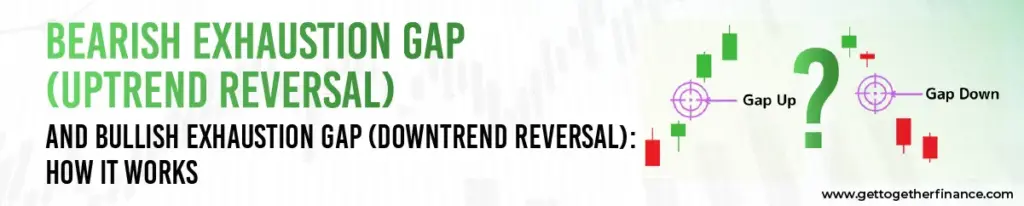
Exhaustion gaps form when a strong trend is about to end and signal traders that the market is about to change its direction. These gaps generally form when buyers or sellers become weak, indicating that the current trend is losing power and a reversal is about to happen.
A bearish exhaustion gap appears after a strong uptrend. The stock opens higher than the previous day, which shows that buyers are active, but soon the price declines with heavy trading volume. This suggests that the buyer weakens and the seller enters the market aggressively. When a bearish exhaustion gap appears, it warns traders that an uptrend is about to end, and the price tends to fall. They usually use this pattern to spot selling or short-selling opportunities
A bullish exhaustion gap appears after a strong downtrend. The stock opens lower than the previous day, indicating that sellers are active, but the price soon increases with heavy trading volume. This suggests that the seller weakens and the buyer enters the market aggressively. When a bullish exhaustion gap appears, it warns traders that a downtrend is about to end, and the price tends to increase. They usually use this pattern to spot buying opportunities and bullish reversals.
Advantages of Trading Exhaustion Gaps
There are several advantages of trading exhaustion gaps. This includes improving trade timing, helping traders identify potential trend reversals, and making better trading decisions with the support of price action and volume analysis. Below, the advantages of exhaustion gaps are explained briefly:
1. Early Trend Reversal Signals: Before any significant price action, an exhaustion gap gives traders a valuable clue about a possible reversal. This enables traders to execute their positions at the right time and benefit from changing market conditions.
2. Useful Across Multiple Time Frames: Whether you are a swing trader, day trader, or long-term investor, exhaustion gaps can be beneficial for you. They are applicable across multiple time frames, including intraday, daily, weekly, and monthly charts.
3. Improves Trading Accuracy With Volume: Exhaustion gaps are generally formed with a sharp rise in trading volume, which makes it more trustworthy. When traders see both the gap and high volume together, they feel more confident before entering a trade. gap formation at daily, weekly, or monthly time frames. This allows swing traders, positional traders, and investors to pick profitable opportunities.
Exhaustion Gaps with Demand and Supply Approach

Demand zones are quite powerful areas to determine the pending orders of institutions. Traders are recommended to trade these zones to pick profitable opportunities. If exhaustion gaps are formed within the company of demand or supply zones then the reliability of your trade doubles, ensuring large profits.
Limitations and Risks of Trading Exhaustion Gaps

As we have discussed the advantages of the exhaustion gaps, there are some limitations and risks associated with them. Traders need to understand this pattern before using it in technical analysis to manage trading risks effectively.
1. High Chances of False Reversals: The biggest limitations of exhaustion gaps are that they can create false reversal signals. Sometimes after an exhaustion gap, the price moves in the opposite direction but then returns to its original trend. Traders who enter a trade too early without proper confirmation can lead to financial losses.
2. Lack of Reliability When Used Alone: When exhaustion gaps are used alone, they do not give full reliability as trading signals. By combining with other tools such as support and resistance, demand and supply zones, or trend analysis, their effectiveness increases.
3. Difficult to Identify in Real-Time: It is easy to identify an exhaustion gap after the price has already moved, but during a live market, it becomes difficult. Many traders mix up exhaustion gaps with other gap types, which leads to confusion and wrong trading decisions.
Why Exhaustion Gaps Can Produce False Signals?

Not all price gaps indicate a true trend reversal, which makes exhaustion gaps unreliable. In some cases, these gaps may arise as a result of market news, temporary volatility, or short-term profit booking. Another common challenge is that the trader struggles to differentiate between exhaustion gaps and continuation gaps on the price chart.
In addition, false signals generally arise when traders fail to wait for proper confirmation before entering a trade. There are two important things: high trading volume and reversal price action, through which an exhaustion gap needs to be confirmed. If these things are missing, the gap is unreliable, and the market will most likely continue moving in its original direction without reversing.
Risk Management When Trading Exhaustion Gaps

Sometimes exhaustion gaps generate false reversal signals; that is why risk management is essential for traders. If they don’t manage risk properly, it only leads to heavy losses. By following a structured approach, traders can protect their capital and manage their risk effectively.
Use Proper Stop Loss: While trading exhaustion gaps, it is important to place a stop-loss. For bearish exhaustion gaps, traders place a stop-loss above the gap candle’s high, while for bullish exhaustion gaps, they place it below the gap candle’s low. This approach helps them minimise losses if the market continues to move in its original direction.
Avoid Overtrading: In the market, not every gap is an exhaustion gap. Traders should only focus on high-quality setups and refrain from entering trades. This structured approach helps them avoid false signals and protect their capital.
Wait for Confirmation Before Entry: One of the most common mistakes that traders make is entering just after the gap forms, which increases the chances of false entries. Therefore, it is advisable to wait for confirmation through reversal candlestick patterns, price action, or strong trading volume before entering a trade.
Exhaustion Gap vs Runaway Gap: Key Differences
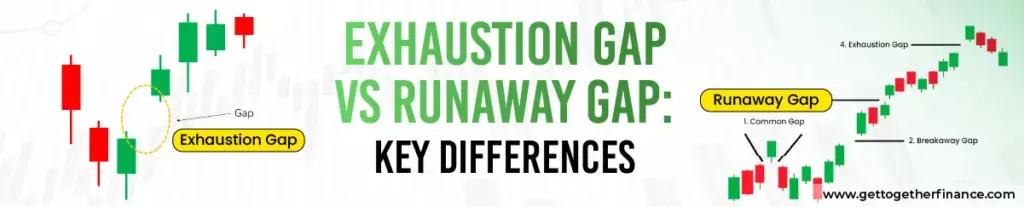
On a chart, exhaustion gaps and runaway gaps look so similar, but they are totally different from each other in technical analysis. An exhaustion gap indicates a trend reversal, whereas a runaway gap signals trend continuation. By understanding teh difference between the two, traders can make better trading decisions and filter out weak trade setups.
| Basis | Exhaustion Gap | Runaway Gap |
| Meaning | Exhaustion Gap is a technical pattern that forms at the end of a strong upward or downward trend | A runaway gap is a price gap that appears during a strong market trend and indicates that the price is likely to keep moving in the same direction |
| Risk Level | It has a higher chance of false signals | It is less risky during market trends |
| Market Psychology | Within an exhaustion gap, market psychology signals that buyers or sellers are becoming weak, which increases the chances of a trend reversal | Within a runaway gap, market psychology signals strong buying or selling momentum, which suggests that the current trend is likely to continue |
| Formation | It forms near the end of a strong trend | It forms in the middle of a strong trend |
| Trend Direction | The exhaustion gap indicates a reversal in trend direction | The runaway gap indicates continuation of the same trend |
| Common Occurrence | It appears after a long uptrend or downtrend | It forms during a strong ongoing uptrend or downtrend |
| Trader Action | Traders seek reversal opportunities | Traders seek opportunities to follow the current trend |
| Trading Volume | It is supported by a higher volume. | It has a high but stable volume |
| Example | Uptrend reverses into a downtrend | The uptrend continues after the gap |
Real-World Exhaustion Gap Examples on Indian Stocks
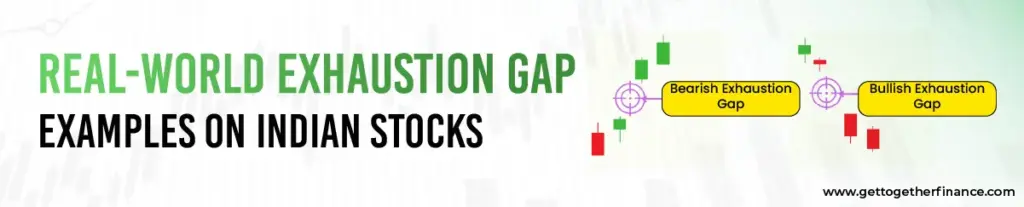
In Indian stocks, exhaustion gaps appear after a strong uptrend or downtrend, which help traders spot potential trend reversals. Through real-world examples, traders can understand how exhaustion gaps work in actual market conditions.
Example 1: Bearish Exhaustion Gap
Assume a stock such as Reliance Industries that has been continuously increasing for numerous weeks. After a strong uptrend, the stock opens above the previous day’s close, leading buyers to believe the price will continue to rise. However, the stock begins to decline with high trading volume rather than continuing to move upward. This shows that the buyer becomes weak and the seller is gaining control, which indicates a potential trend reversal.
Example 2: Bullish Exhaustion Gap
Now, imagine a stock such as Tata Motors that has been continuously declining for a long time. The stock opens at a lower price, suggesting the downtrend may continue. However, buyers aggressively enter the market and push the price higher on strong volume.
Key Takeaways: Exhaustion Gap Trading
In the stock market, exhaustion gaps assist traders in identifying potential trend reversals. A bearish exhaustion indicator that an uptrend is about to reverse, while a bullish exhaustion gap signals the end of a downtrend. When strong trading volume and price action supported these gaps, it became more reliable.
Although exhaustion gaps can also generate false signals, traders should not fully depend on these chart patterns while making trading decisions. Also, they need to place stop-loss, risk management strategies, and confirm the setup.
If traders want better accuracy in trading, they should combine exhaustion gaps with technical analysis tools. These include trend analysis, demand and supply zones, and support and resistance