Free vs Paid Stock Market Courses: Which Is Better For You in 2026
- Updated on :
- 49 Views
- by Suhani

 Instagram
We often find ourselves in a situation where we get stuck between choosing something free or something paid. Whether it’s a product, a service, a course, or even just a meal, free has its place and paid has its own value.
But if we talk about today, in 2026, especially regarding stock market learning, we realize how much things have changed. You could say 2026 is a very strange time to become a trader. Since AI has entered the market, “Retail Trading” has become a global obsession.
Everyone wants to start trading, but they are still stuck when it’s time to actually learn. Why? Because if you open YouTube and search “how to trade,” you will see thousands of different videos. But at the same time, you see ads for Masterclasses that cost as much as a full college semester. This is the big difference between free and paid trading courses.
This is what we call being at a “Crossroads.”
To solve this confusion, this blog has all the answers you need. When looking at a free vs. paid stock market course comparison, you need to know what you are actually getting.
- Free vs paid stock market courses?
- Real courses or just random tips?
- Are free stock market courses enough, or does it take a full year of dedicated learning?
Let’s find out and clear the clutter in your mind.
What Are Free Stock Market Courses?
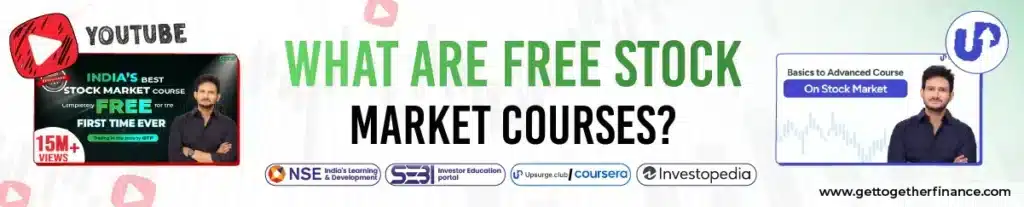
Free stock market courses are basically any educational content available at zero cost. We are talking about platforms like YouTube, financial websites, and open-access learning portals. However, “free” can still come with a cost in terms of time and effort. In the world of trading, comparing a free trading course to a paid one reveals something important. “Free” often means spending months filtering through a mountain of content. You end up wasting time removing all the unnecessary junk just to find one good lesson.
In reality, we see it every day: one video tells you, “Use this screener to find the best stocks,” and the very next video will tell you, “That indicator is completely useless.” At the end of the day, all this does is create confusion and frustration. It leaves many people asking themselves, “Are free stock market courses enough?”
Honestly? Not always. Free stock market courses are great for building your foundation and helping you clear the basics. And to be clear, “free” doesn’t always mean low quality. In fact, some of the most respected free vs. paid trading education resources in India are actually available for free.
Where to Find Genuinely Good Free Resources?
- YouTube Channels: There are many channels that are considered the best stock market resources in India. These include GTF – A STOCK MARKET INSTITUTE, which covers everything from absolute basics to advanced knowledge on the stock market with complete technical analysis training.
- NSE India’s Learning & Development: The National Stock Exchange runs free beginner-level modules on its website.
- SEBI Investor Education portal: Regulatory-backed, unbiased basics about markets, mutual funds, and investor rights.
- Upsurge/Coursera: These platforms also offer free resources on stock market education.
- Investopedia: A widely used financial education website offering glossaries, tutorials, and learning resources.
- GTF’s free stock market certification course is also a great option that gives you both foundational knowledge and a certificate to show for it.
As we have discussed the free stock market course, now it’s time to explore paid one.
What Are Paid Stock Market Courses?
In a free vs. paid stock market course comparison, paid courses are completely different because they are structured. They aren’t just random videos; it’s a complete structure designed by instructors to take you deep into trading and investing strategies. Along with the lessons, you usually get support, a community of other traders, and someone to hold you accountable.
In 2026, the range of these courses is huge. You can find recorded modules for just ₹499, or you might see live mentorship programs that cost more than ₹50,000. But here’s the truth: not all paid courses are the same. Some are life-changing and extraordinary, while others are just a waste of money or even scams.
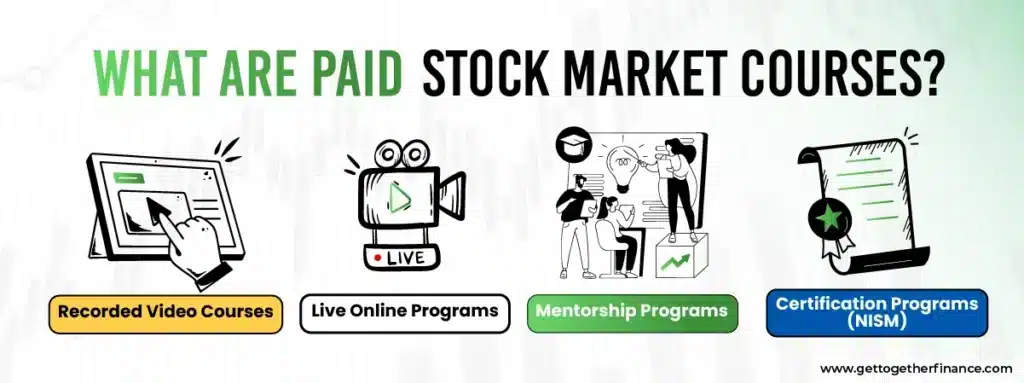
If you’re wondering whether you should choose a paid trading course, it is important to know about the different types of courses available. Here are the main types:
- Live Online Programs: These are scheduled classes where you can ask questions and clear your doubts in real-time. If you’re exploring the best online stock market courses in India, Trading in the Zone Live by GTF stands out as one of the most comprehensive programs for complete basic-to-advanced training.
- Recorded Video Courses: You pay once and watch at your convenience. There’s no live interaction, and they usually cost between ₹500 and ₹5,000.
- Mentorship Programs: This is considered a premium level. You get one-on-one or small-group coaching from an actual trader. Because it’s so personal, it can cost more than 20,000.
- Certification Programs (NISM): If you want a career in finance, these are essential. They are industry-recognised and very affordable (around ₹1,500–₹3,000 per exam).
After discussing the free and paid stock market course, let’s now understand the difference between them.
Key Differences Between Free and Paid Trading Courses

To make your decision easier, let’s look at the two paths side-by-side. In 2026, the real difference isn’t just the price tag; it’s about the quality of your time and the accuracy of your chosen course.
| Factor | Free Courses | Paid Courses |
| Structure | Scattered, self-directed | Organised curriculum with milestones |
| Depth | Surface to intermediate | Basics to advanced |
| Mentorship | None | Often included (varies by program) |
| Live Interaction | Rare (comment sections) | Regular (webinars, Q&A, Zoom) |
| Certificate | Rarely | Usually yes |
| Community Access | None / public forums | Private groups, peer networks |
| Content Updates | Inconsistent | Usually updated regularly |
| Accountability | Zero — you’re on your own | Built-in (assignments, deadlines) |
| Quality Control | Anyone can publish | Usually vetted instructors |
| India-Specific Content | Good (Varsity, NSE) | Varies widely |
| Career Value | Low | Moderate to High |
| Best For | Self-starters, beginners | Serious learners, career switchers |
| Time To Learn | Long (1-2 years) | Short (2-3 months of Focused learning) |
By covering the differences between free and paid trading courses, let’s look at who could benefit from starting with free and paid stock market courses.
Who Should Choose Free Stock Market Courses?
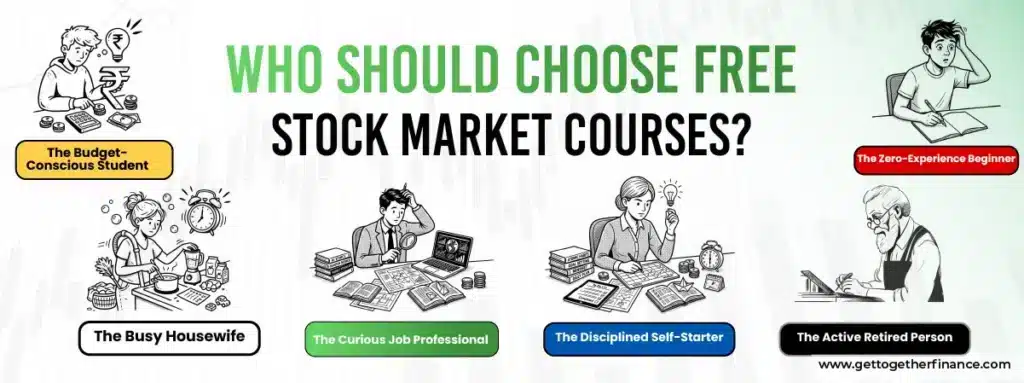
The beauty of the stock market is that it doesn’t care about your age, your degree, or how much money is in your bank account today. It only cares about your knowledge. But when you’re starting, the biggest hurdle is the “entry fee.” For such people, the path to choosing between free vs. paid stock market courses is often the smartest first step:
1. The Budget-Conscious Student
If you are a student or someone just starting with zero savings, don’t spend your last rupee on a course. Use free resources like YouTube to learn the theory first. Your limited money is better spent as your first trading capital once you’ve learned the basics for free.
2. The Busy Housewife
If you are managing a home and want to start a side hustle, free courses allow you to learn at your own pace without any financial pressure. It’s a great way to build confidence and understand the language of money during your free time without risking the family budget.
3. The Curious Job Professional
If you have a 9-to-5 job and just want to learn more about trading, then don’t jump into a ₹50,000 mentorship immediately. Start with free videos to see if you actually enjoy looking at charts after a long day at work. A useful tool to complement your learning is the best stock screener in India — it lets you practise spotting setups in real time, even while you’re still in the learning phase.
4. The Disciplined Self-Starter
Some people are naturally good at researching and connecting the dots. If you have the patience to filter through the noise and build your own syllabus, are free stock market courses enough? For you, yes. You can save a lot of money by being your own teacher.
5. The Active Retired Person
If you’ve finished your professional innings and want to keep your mind sharp, the free application (Get Together Finance App) is a great option. It offers a wealth of knowledge without the stress of paying any hidden fees. It’s a peaceful way to learn a new skill and stay connected with the modern economy.
6. The Zero-Experience Beginner
If you don’t even know what a “Nifty” or “Sensex” is, paying for a high-level course is a waste. Start for free to clear the clutter in your head. Once you know the basics, you’ll be in a much better position to decide if a paid trading course is worth it for your next level.
Who Should Choose Paid Stock Market Courses?
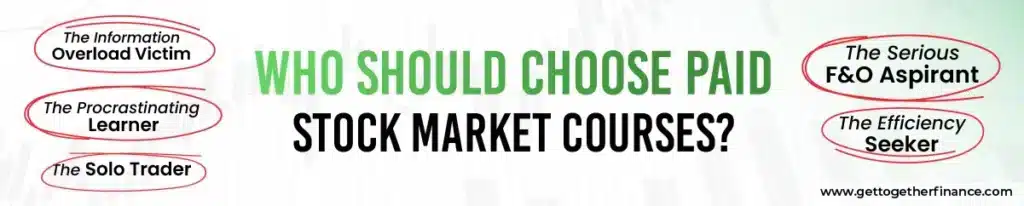
There comes a point where “free” isn’t enough. In many cases, paying for your education is actually the smarter financial move. When you look at the difference between free and paid trading courses, you’ll see that paying is often about buying back your time. You should consider a paid program if you fit these categories:
1. The Information Overload Victim
If you have watched 50 YouTube videos and read all the blogs but still don’t know how to place your first trade, you need structure. A paid course takes you out of the “loop” and gives you a clear A-to-Z roadmap, so you stop feeling lost.
2. The Serious F&O Aspirant
Futures and Options are high-risk. Recent data shows that nearly 90% of retail F&O traders lose money, with average losses hitting over ₹1 Lakh a year. If you are entering this “danger zone,” is a paid trading course worth it? Absolutely. The cost of a course is much lower than the cost of losing your entire capital on one bad, uneducated trade. For anyone serious about options specifically, a dedicated course for options trading can make the difference between protecting your capital and blowing it on an uneducated trade.
3. The Procrastinating Learner
Free content asks nothing of you, which is why most people never finish what they start. When you pay, you get accountability. Live classes, assignments, and deadlines give you the “push” you need to actually finish the course and start trading.
4. The Solo Trader
Trading from your bedroom can be lonely and depressing when things go wrong. Paid courses give you a community, a group of people who are on the same journey. Having a “trading buddy” or a mentor to talk to is an invaluable asset that you simply won’t find on a free platform.
5. The Efficiency Seeker
If you are a busy professional whose time is worth more than the course fee, don’t waste two years on “trial and error.” When you decide that beginners should pay for trading courses, you are choosing to pay for a proven system rather than trying to invent one yourself from scratch. Pair that structured learning with the best automatic Demand & Supply indicator, and you’ll have both the knowledge and the tools to trade with real confidence from Day 1.
Now that we’ve looked at who may consider a paid stock market course, let’s tackle an important question: can someone learn to trade using only free courses?
Can Free Courses Alone Help You Become a Trader?

The short answer? Yes, but it’s the hardest way to do it.
If you have infinite patience and the research skills of a detective, you can absolutely become a trader using only free resources. In fact, some of the most successful retail traders in India started with nothing but YouTube and a lot of grit.
However, you need to understand the “hidden cost.” When you learn for free, you are the one who has to:
- Filter the Noise: You have to decide which YouTuber is telling the truth and which one is just selling a “dream.”
- Fix Your Own Mistakes: When you lose money (and you will), there is no mentor to tell you why it happened. You have to figure it out yourself while your capital is shrinking.
- Build the Blueprint: Free courses give you the bricks, but they don’t give you the architecture. You have to understand everything by yourself.
So, are free stock market courses enough? They are enough to get you started, but they are rarely enough to make you a professional.
Now that we’ve covered what free courses can and can’t offer, let’s look at when a learner might decide to switch to a paid trading course.
When Should You Consider a Paid Trading Course?
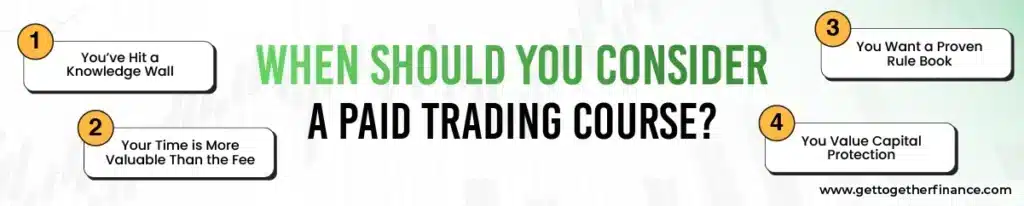
Most people wait too long to buy a course. They spend months losing money in the market and then decide to learn. The smarter way is to consider a paid program when:
- You’ve Hit a Knowledge Wall: You know what a support and resistance line is, but you still don’t know exactly where to click ‘Buy’ and ‘Sell.’
- Your Time is More Valuable Than the Fee: If you are a working professional, spending 5 hours a day searching for “the right strategy” is costing you more than a ₹10,000 course fee.
- You Want a Proven Rule Book: If you are tired of guessing and want a back-tested system that tells you exactly what to do in every situation, it’s time to look at a free trading course vs paid trading course comparison and choose the structured path.
- You Value Capital Protection: If you have ₹1 Lakh to trade, spending ₹10,000 on education to protect that capital is a much better move than “learning by losing” ₹50,000 in the market.
Conclusion
If you are a total beginner, start for free. Don’t spend a single rupee until you’ve cleared the clutter in your mind. Go through the basics on YouTube or Varsity and see if you actually enjoy the process. But the moment you decide that you want to be a professional, whether it’s to manage your family’s wealth, build a second income, or change your career, go for a structured, paid program. In 2026, the real edge isn’t just knowing “how” to trade; it’s having a mentor and a system that keeps you disciplined when things get tough.
Which path are you on today? Free vs. paid stock market courses? The slow and steady free route or the fast-tracked professional one? The choice is yours, but remember the market always rewards the prepared mind.