
Securitization: Definition, Pros & Cons, Example
- Updated on :
- 1861 Views
- by Arun Singh Tanwar

 Facebook
 Instagram
 Youtube
 Linkedin
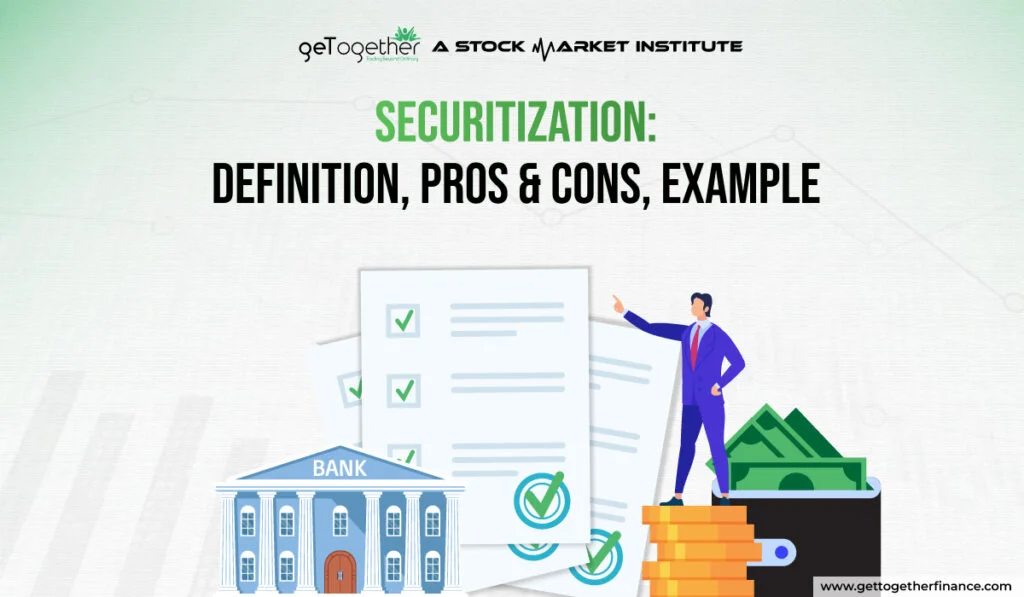
Imagine a world where a car loan you provide or a mortgage payment you receive could be transformed into a tradable security on the stock market. That’s the power of securitization!
Securitization is a vital financial process which fundamentally changed capital markets and allows greater access to credit. This blog dives deep into the very essence of securitization, exploring its definition, the potential benefits and drawbacks it presents, and even showcasing a real-world example to bring the concept to life.
What Is Securitization?

Securitization is the process of converting illiquid assets into securities that can be traded on the financial markets. In simpler terms, it involves pooling different types of debt obligations into securities sold to investors. This process is also known as asset securitization. It helps holders of illiquid loans raise capital by selling them on secondary markets.
The pooled assets act as collateral for the securities, and investors receive payments from the cash flows of underlying debt repayments. This practice allows lenders to convert illiquid assets into tradable securities and replenish funds, while also offering investors access to investment-grade securities backed by diversified asset pools.
Key Participants in Securitization

Securitization involves various participants that play an essential role in gathering payments, improve loan pooling process, risk evaluation, and capital distribution to investors.
- Originator
This is mainly a bank or financial institution that makes loans such as mortgages, personal loans, or car loans.
- Special-Purpose Vehicle (SPV)
It is a separate entity that is created to buy the loan from the originators. Also, it combines all loans into one pool and protects investors if the bank faces financial problems.
- Investors
Investors are people or institutions who buy the securities issued by the SPV. They get a monthly income when borrowers repay their loans and can select different risk levels based on their investment goals.
- Credit rating agencies
Credit rating agencies are organizations that examine the risk level of securities. They give ratings (AA, AAA, BBB, etc.) to assist investors in understanding the safety level of their investment. The higher ratings highlight the safer investment and lower risk.
- Servicer
Servicer is the company responsible to gather the monthly payments from borrowers and making sure that the money reaches investors through the SPV. The original bank continues this role and maintains the day-to-day loan management operations.
Key Insight: Investors should not only depend on credit cards. They have to evaluate loan maturity, borrower profile, economic conditions, and asset quality before investing.
Common Asset Classes Used in Securitization
- Mortgage loans (MBS): Home loans are grouped and sold to investors as investment products.
- Auto loans: Car loans are grouped and sold to investors as investment products.
- Credit card receivables: Pending credit card payments that borrowers still have to repay.
- Commercial loans: Business and company loans are grouped and sold as securities.
- Student loans: Numerous education loans are combined and converted into investment securities.
Key Insight: The securitization market grows when the economy grows, because more people take loans and investors want better returns. When the economy slows down, securitization also goes down when more borrowers stop their loan repayment.
“When securitization is done properly, it becomes easier to get money and distribute risk rather than keeping it in one place,” — Alan Greenspan
Why Securitization Is Used?

Securitization is mainly used in the financial system because it assists lenders in lowering risk, managing funds carefully, and developing attractive investment opportunities for market participants.
- Improves Liquidity for Lenders
Scrutinization enables lenders to convert illiquid assets, such as loans, into tradable securities. This assists them in generating funds quickly and ensures continuous accessibility of funds for issuing new loans.
- Frees up the Balance Sheet
When lenders remove loans from their balance sheets through securitization, it makes their financial position stronger. It gives them space to issue more loans and invest their money in other opportunities.
- Enable broader Capital Market Participation
It enables different kinds of investors, like retail and institutional participants, to invest in systematic financial products and enhance growth opportunities in the capital market.
- Transfer Credit Risk
When lenders sell loan pools to investors, the risk of borrowers not repaying the loans is shifted to those investors. This helps lenders in reducing the risk of losing money.
- Lower Funding Cost
Securitization offers the availability of funds at a low rate of interest because securities supported by different loans are generally safer for investors.
How Securitization Works
Securitization involves pooling various types of debt obligations, such as loans or receivables, and transforming them into securities that can be sold to investors. This process is typically undertaken by a special purpose vehicle (SPV), which is a separate legal entity created specifically for the purpose of securitization.
In India, securitization is governed by the Securitisation and Reconstruction of Financial Assets and Enforcement of Security Interest (SARFAESI) Act, 2002. The Act provides a legal framework for the securitization process and allows banks and financial institutions to recover non-performing assets (NPAs) by selling them to asset reconstruction companies (ARCs) or through securitization.
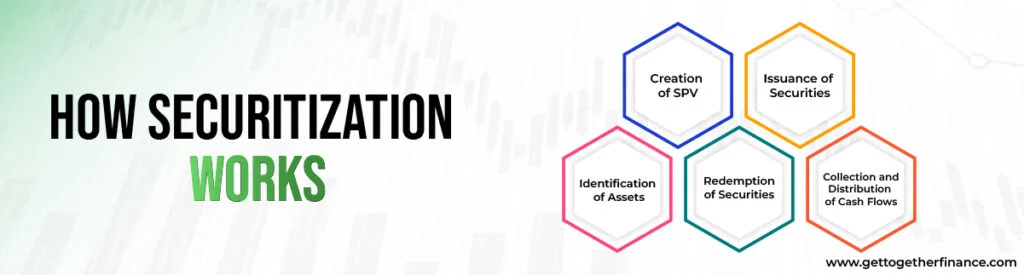
The securitization process in India typically involves the following steps:
- Identification of Assets: Banks and financial institutions identify a pool of assets, such as loans or receivables, that they wish to securitize.
- Creation of SPV: An SPV is created to purchase the identified assets from the originator (the bank or financial institution) using funds raised from the issuance of securities.
- Issuance of Securities: The SPV issues securities backed by the cash flows from the underlying assets. These securities are then sold to investors.
- Collection and Distribution of Cash Flows: The SPV collects the cash flows from the underlying assets and distributes them to the investors in accordance with the terms of the securities.
- Redemption of Securities: The securities are redeemed over time as the cash flows from the underlying assets are received by the SPV.
Advantage & Disadvantage of Securitization

Securitization has become an important tool for banks and financial institutions in India to manage their balance sheets and improve liquidity. It offers a double-edged sword for the Indian market. On the positive side, it unlocks the value of illiquid assets like loans held by banks, creating a more liquid market and freeing up capital for further lending. Investors gain access to a new asset class for diversification, while banks can spread loan risk across multiple investors. Businesses also benefit from potential access to additional capital through securitization.
However, there are limitations to consider. Moral hazard can arise if banks become less stringent in credit assessment, potentially leading to defaults. The complexity of securitized products can make it difficult for some investors to understand the true risk involved, and a domino effect of defaults could destabilize the financial system. Additionally, high fees associated with the process can eat into potential returns.
Here let’s take a look at the benefits and limitations of securitization in a simplified way:
| Advantage | Disadvantage |
| Increased Liquidity | Moral Hazard |
| Diversification for Investors | Opacity and Complexity |
| Risk Sharing | Systemic Risk |
| Access to Capital | High Fees |
Types of Securitization
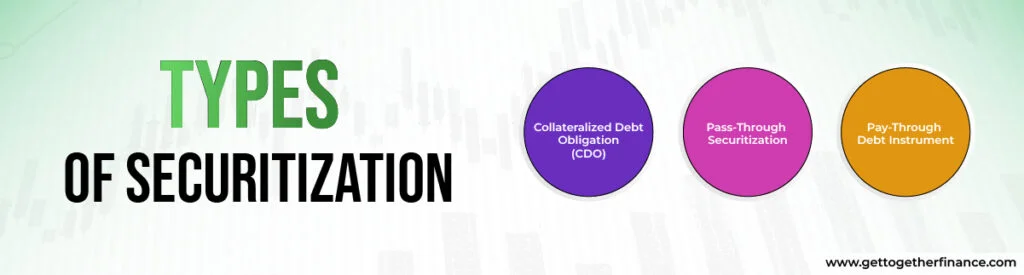
Securitization takes illiquid assets, like mortgages or car loans, and transforms them into tradable securities. Here’s the breakdown:
- Collateralized Debt Obligation (CDO): This securitization structure involves pooling together a variety of debt instruments, such as mortgages or car loans, and subsequently issuing securities backed by this diversified pool. Investors can acquire tranches of these securities, with varying degrees of risk and potential return. Higher risk tranches typically offer the potential for greater returns.
- Pass-Through Securitization: In this, underlying assets, frequently consisting of mortgages, are grouped together. The resulting security directly reflects the cash flow generated by those assets. Investors receive a proportional share of the principal and interest payments made on the original loans.
- Pay-Through Debt Instrument: This structure differs from the pass-through approach in that investors do not hold direct ownership of the underlying assets. The issuer retains responsibility for managing the assets and determines the distribution of cash flow to investors. This approach offers the issuer greater flexibility but may result in less transparency for investors.
This process unlocks the value of illiquid assets and creates a new asset class for investors. We’ll explore the advantages and disadvantages of securitization in the next section.
Also Read: Stock Warrants
Example of Securitization In India

An example of securitization in India can be seen in the case of a bank that wants to securitize a pool of auto loans. The bank identifies a pool of auto loans that it has disbursed to borrowers. These loans have regular monthly payments and are considered to be a stable source of cash flow.
The bank then transfers these auto loans to a special purpose vehicle (SPV), which is a separate legal entity created specifically for this purpose. The SPV purchases auto loans from the bank using funds raised from the issuance of securities.
The SPV then issues securities backed by the cash flows from the auto loans. These securities are typically divided into different tranches, each with a different level of risk and return. The senior tranches are considered to be safer and receive priority in receiving payments from the cash flows, while the junior tranches are riskier but offer higher potential returns.
These securities are then sold to investors, who receive regular payments from the cash flows generated by the auto loans. The bank benefits from this securitization process by freeing up capital that was previously tied up in auto loans, allowing it to issue more loans and earn more interest income.
Who Uses Securitization?
- Financial Institutions: Financial institutions securitize loans to enhance their balance sheets and maintain an adequate liquidity level.
- Structured Finance Professionals: Experts in structured finance develop, execute, and examine securitization deals.
- Banks & NBFCs: Banks use securitization to generate cash, lower financial risk, and manage liquidity, whereas NBFCs use it to support long-term funding stability.
- Institutional Investors: They invest in securitized products for returns
Risks Involved in Securitization

There are various types of risk involved in securitization, which include:
- Credit Risk
This is the risk when borrowers fail to repay their loans. If many borrowers fail to repay, then investors could lose their money. Although spreading loans helps in spreading the risk, a recession can make borrowers unable to pay at once, which causes a big loss.
- Liquidity Risk
Sometimes, it is difficult to sell securities in the market, mainly during financial crises. If investors have to sell their securities quickly, then they struggle to find buyers or will be forced to sell at a discount. This inability to sell fast can leave investors stuck with unwanted securities.
- Moral Hazards (Originator Incentive Mismatch)
When the banks know they will sell the loans to an SPV, then they become less careful about their borrowers. The originator may approve bad loans to earn money, as they won’t lose anything if the people don’t pay.
- Repayment Risk
Borrowers might pay off their loans earlier when the interest rate falls. This is good, but not for investors. They lose future earnings and may have to reinvest their money at lower rates.
- Complexity Risk
These securities are highly complex with multiple layers and complicated payment structures. Numerous investors don’t fully understand what they are buying, which makes it difficult to evaluate the real risk.
Securitization vs Traditional Financing

Let’s understand the difference between securitization and traditional financing from the table given below:
| Aspect | Securitization | Traditional Loans |
| Risk Transfer | Yes | No |
| Liquidity | High | Low |
| Complexity | High | Low |
| Investor Access | Broad | Limited |
Securitization and the 2008 Financial Crisis

The 2008 financial crisis outlines how securitization can impact the global financial system when loans are given carelessly, and rules are not properly assessed.
Subprime Mortgage Securitization
Banks began to offer loans to individuals with poor credit histories (subprime borrowers), who have a lower ability to repay loans. These high-risk loans were grouped and converted into securities. When people stopped paying, and house prices decreased, everything collapsed. Bad and good loans were combined, making it impossible to determine what was safe.
Over-Reliance on Credit Ratings
Investors mainly rely on credit ratings agencies, which frequently give high ratings to securitized products that are really risky.
Misaligned Incentives
Lenders made money by selling and giving loans, rather than checking if borrowers could repay them. This resulted in a higher risk in the financial system and poor lending practices.
Why Securitisation Itself Wasn’t the Problem?
Scrutinization is not a harmful practice. The crisis occur beacuse of irresponsible lending practices, poor risk evaluation, and weak regulations. When securitization is carried out responsibly, it boosts funding and lowers financial problems.
Conclusion
Securitization presents a valuable tool for the Indian market, but careful consideration of both advantages and disadvantages is essential. Striking the right balance between innovation and risk management will be key to unlocking its full potential for economic growth and a thriving investment landscape. Remember – before flipping a coin, know both sides well and select your option wisely.
FAQs
1. Which Agencies Regulate Securitization?
In India, securitization is regulated by multiple agencies to ensure transparency and stability. These include:
Securities and Exchange Board of India (SEBI): Oversees the issuance and trading of securitized products like Asset-backed Securities (ABS).
Reserve Bank of India (RBI): Sets guidelines for banks originating and holding securitized assets, focusing on risk management and capital adequacy.
2. What Is the Difference Between an MBS and an ABS?
Both MBS (Mortgage-backed Security) and ABS (Asset-backed Security) are types of securitized debt instruments. However, they differ in the underlying assets:
MBS: Backed by a pool of mortgages, representing loans secured by real estate.
ABS: Backed by a wider variety of assets, such as car loans, student loans, or credit card receivables.
3. What Are Securitized Debt Instruments?
Securitized debt instruments are financial products created by pooling illiquid assets (like loans) and transforming them into tradable securities. These securities represent ownership in portions of the underlying asset pool, with varying risk profiles depending on the specific tranche. Examples include Mortgage-backed Securities (MBS) and Asset-backed Securities (ABS).
4. What Is the Purpose of Securitization?
Securitization takes illiquid assets like loans and turns them into tradable securities. This unlocks their value, frees up capital for lenders, and creates a new investment option for diversification. It also helps spread loan risk across multiple investors.