
Trading Psychology: Meaning, Key Emotions, Biases and How to Build a Strong Trading Mindset
- Updated on :
- 1535 Views
- by Suhani

 Instagram
There are two ways to enter the stock markets. Either you buy stocks for the long-term and hold them as an investment, or you can take positions for the short-term with small targets and book profits quickly. Both these styles are successful. But trading is the go-to style for thrill seekers.
Here, it is important to understand that this is the biggest mistake you can make. This is how most traders lose a fortune. Trading is not about seeking thrills. Rather, it is about the strategy and timing. Here comes the role of trading psychology.
Stock markets are highly volatile, and things can go south almost instantly. It is important for a trader to control themselves and refrain from making hasty, impatient, and emotional decisions. Just like a sailor manages the dangerous waves of an ocean storm, a trading mindset prepares you to make the right decisions in adverse situations.
In this blog, we discuss everything about behavioral finance, a combination of psychology and economics that talks about biases and emotions overriding logic. We will also cover how you can become a successful trader by learning and applying trading psychology.
What Is Trading Psychology and Why Does It Matter More Than Strategy?

Trading psychology refers to the emotions and mental states that influence the decision-making of a trader. It is not the same as general psychology, which studies overall human behavior. Trading psychology focuses specifically on how individuals react to risk, loss, reward, uncertainty, and distress while trading. It has three main parts. The first is trading mindset, which is how you interpret market events. The second is emotions in trading, which are the impulsive and irrational reactions that come up under pressure. The third is discipline, which is the ability to control those impulses and stick to your plan.
This is also why trading psychology often matters more than strategy. You can have the best researched strategy in the world, but if fear or greed takes over the moment the price moves against you, that strategy becomes useless. Therefore, having a strong trading mindset means having a mix of traits such as emotional intelligence, discipline, self-control, and awareness of your own thinking. These traits help you follow your plan consistently, even under pressure.
To become a successful trader, you cannot simply rely on your skills in technical analysis. You also need qualities related to behavioural finance, such as consistency, risk management, loss control, and emotional stability. These qualities keep you grounded when the market becomes volatile.
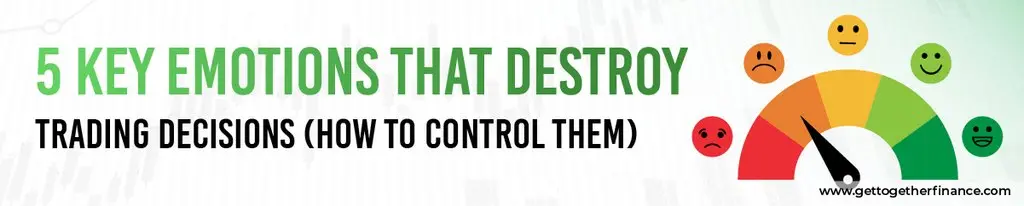
5 Key Emotions That Destroy Trading Decisions (How to Control Them)
Fear in Trading: Fear of Loss and FOMO
Once you are in a difficult situation, fear is your biggest enemy. It neither allows you to take risks nor lets you enjoy the fruits of your labor. There are 2 types of fears:
Fear of Loss: When you invest your capital in stocks, the biggest risk you face is that of a loss. As a result, you lose the opportunity of entering fruitful trades or exit too early in fear of loss. The rule here is simple. Decide your stop loss before you enter the trade, and once it is set, trust it instead of reacting to fear in the moment.
Fear of missing out (FOMO): Instead of staying ahead of the curve, traders only get onto the bandwagon later on, driven by the fear of missing out. For example, suppose a stock has already moved up 10 per cent in a session, and everyone is talking about it. By the time you enter, most of the price movement has already materialised, and the stock often falls back soon after. The rule here is to wait. If you feel FOMO building up, wait 15 minutes before acting. In most cases, the urge passes, and you save yourself from a bad entry.
Greed in Trading: Overleveraging and Holding Too Long
Another emotion in trading you should avoid is greed:
Holding on too long: When you bag a profitable trade, it is natural to want more profits. This greed can cloud your judgment, stopping you from booking profits. Usually, it ends in the reversal of price trends. For example, suppose your trade moves up by 20 percent, but instead of booking it, you wait for more. The price reverses, and by the time you exit, your 20 per cent gain has shrunk to just 5 per cent. The rule here is to always set a target before entering a trade, and honour it once it is hit.
Over-leveraging: In order to chase higher returns, you might try using leverage accounts and enter higher-value trades with marginal payments. It is extremely risky and can destroy your entire savings. This is especially dangerous for Indian traders using F&O, where a small margin controls a large position, so even a small move against you can wipe out a big part of your capital. The rule here is to use leverage only within the limits you have decided in advance, and never increase your position size out of excitement.
Hope and Regret: Why Emotional Attachment Costs Traders Money
Unlike long-term investors, traders have to make momentary decisions to hang on or move on. They cannot afford to lose time on one trade:
Hope: Suppose you make a bad trade; it’s wiser to square off and book the loss instead of hoping that it will turn around. This is the “it will come back” trap, and it is dangerous because of how recovery math works. If a trade falls by 50 per cent, it needs a 100 per cent gain just to get back to where it started. The way to break this cycle is to follow a hard stop loss rule. Decide your exit point before you enter the trade, and treat it as non-negotiable.
Regret: If you regret your mistakes made in past trades, it will affect your current decisions. You might end up hesitating or even overcompensating. It’s better to accept and move on. This is hindsight bias at work, and the way to break it is to review your trade journal calmly after every loss, learn from what happened, and move forward without carrying that regret into your next trade.
Revenge Trading: What It Is and Why It Wipes Out Accounts
Revenge trading happens when you re-enter the market immediately after a loss, with the single goal of winning back the money you just lost. This is one of the most damaging patterns in trading, because the damage compounds. Your emotional state is already compromised right after a loss, so the quality of your setup drops, and traders often increase their position size to recover the loss faster, which only adds more risk.
To control revenge trading, follow these three rules. First, take a mandatory break of at least 30 minutes after every losing trade before placing another one. Second, set a limit of 2 losses in a day, and once you hit that limit, stop trading for the day. Third, review your trade journal before any reentry.
Overtrading: How Too Many Trades Drain Your Capital and Confidence
Overtrading means taking more trades than your system allows, often driven by boredom, FOMO, or overconfidence after a winning streak. The cost adds up quickly, even before profit or loss comes into the picture. For example, if you take 10 trades in a day and each one costs ₹20 in brokerage, that is ₹200 spent on costs alone. Beyond the direct cost, overtrading also leads to decision fatigue, since the more trades you take, the harder it becomes to make a clear decision on each one.
To control overtrading, follow these two rules. First, set a maximum of 2 to 3 trades per day. Second, stop trading the moment you hit your daily loss limit, even if you feel the urge to keep going.
Why Trading Psychology Is the Difference Between Consistent Profits and Consistent Losses

When we talk about trading psychology, we are discussing the need for emotional control. It is important to see whether your decisions are driven by emotions or logic. Emotional control can prove to be the defining factor between your success and failure as a trader. Here’s why it is important to control your emotions in trading:
Discipline prevents you from panic selling.
Patience allows you to wait for the ideal setup.
Mental strength helps you accept losses and move on.
Look at the bigger picture. If you are gaining overall, you are successful.
Consider this. According to a SEBI study, 89 per cent of individual traders in the equity F&O segment incurred losses, and this figure rose to 91% in FY24-25. In other words, around 9 out of 10 retail traders end up losing money. So what does the profitable minority do differently? It usually isn’t a secret strategy or insider information. It’s psychology and discipline. The 10% who profit tend to follow a fixed plan, accept small losses early, and avoid the emotional traps of fear, greed, hope, and revenge trading that drag the other 90% down.
This becomes clearer when you break trading down into its three stages: entry, holding, and exit. At the entry stage, emotional traders jump in out of FOMO or excitement, without waiting for their actual setup. At the holding stage, emotional traders either panic and exit too early in fear, or hold on too long out of greed and hope. At the exit stage, emotional traders often exit at the worst possible time, either booking a loss in panic or giving back profits by exiting too late. A disciplined trader, on the other hand, follows the same plan at every stage, regardless of what emotion is telling them to do.
What the 10% Do Differently?
They are not smarter. They are simply more disciplined.
- They have a written trading plan before the market opens
- They follow stop losses without negotiating with themselves
- They do not trade to recover losses
- They review their journal, not just their P&L
Psychology is not a soft skill in trading. It is the skill.
Read More – Difference Between Trading and Investment
5 Common Psychological Biases That Hurt Indian Traders (And How to Overcome Them)
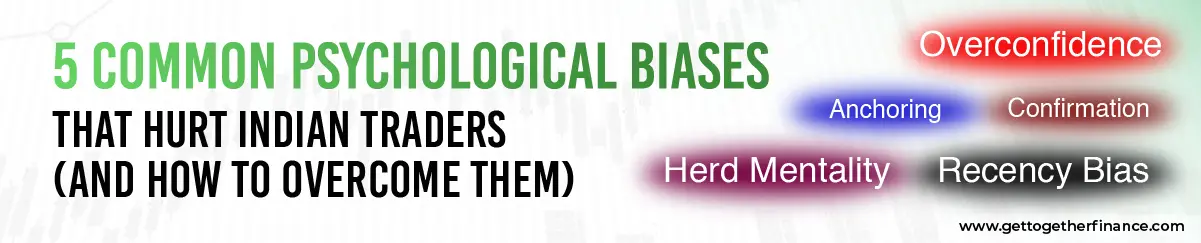
Emotions are not the only enemy. Sometimes the damage is done by biases, deeply ingrained mental shortcuts that feel logical but quietly destroy your trading decisions. Here are the five most common ones, with real Indian market examples and one fix for each.
| Bias | What It Means | Indian Market Example | How to Overcome It |
| Overconfidence | Believing you have the market figured out | After 3 winning Nifty trades, you double your position size, and one loss wipes out all three wins | Cap your position size. Rules don’t change after a winning streak |
| Confirmation Bias | Only looking for information that supports what you already believe | You are bullish on Reliance, so you ignore bearish signals and only read positive news | Before any trade, actively look for one reason not to take it |
| Recency Bias | Giving too much weight to what just happened | Nifty fell for 3 days in a row, so you assume it will fall again tomorrow | Base decisions on your system, not on the last 3 candles |
| Anchoring | Getting stuck on one price point | You bought a stock at ₹500. It is now at ₹300 with weak fundamentals—but you will not sell because “it was worth ₹500.” | Ask yourself, would I buy this stock today at this price? If not, exit |
| Herd Mentality | Following the crowd without independent analysis | A stock is trending on Twitter, or a Zerodha community tip comes in—you buy without checking charts or fundamentals | Never enter a trade you cannot justify with your own analysis |
How to Develop a Strong Trading Mindset: 4 Habits of Disciplined Traders
We have been talking about the trading mindset the entire blog, but what are the habits and traits you need to develop to become a successful trader? What are the behaviors suggested by experts for traders in their trading psychology books? Let’s find out:
Self-Awareness
Being aware is the first step. Knowing your emotional impulses and triggers can help you pause and recalibrate your attitude. To become self-aware, you should ask yourself these questions:
- Do you panic in a volatile market?
- Do you become overconfident after a profitable trade?
- Does an adverse situation make you anxious, and do you make wrong decisions?
Discipline
Once you are aware of the emotional impulses, you need discipline to control them. You can follow a set of principles or guidelines to become a disciplined trader:
- Stick to the trading plan.
- Don’t pay heed to the market noise.
- Look at the long-term picture.
- Respect your targets and stop losses.
- Don’t engage in revenge trading.
Patience
For a trader, patience is a virtue and an ultimate friend. Professional traders do not enter or exit the markets haphazardly. Rather, they wait for the market to set up according to their preference. Once their strategy aligns with the market, they enter the trade. This process is important to ensure that you do not overtrade and burn out.
Adaptability
As the markets evolve, you need to adapt. Traders who don’t adapt become obsolete. A good trader always keeps an eye on:
- Trend changes
- News events
- Shift in market sentiments
5 Practical Tools to Improve Your Trading Psychology

Here are some tools and tips you can use to develop a strong trading psychology:
Journaling Trades: Track Decisions, Outcomes, and Emotional States
Recording is important. When you continuously track every trade and record the reasoning and emotions, you will see the emergence of a pattern that works for you.
- When Setting Up a Trade: Note the entry, exit, target, and stop loss points.
- The emotional state: Record whether you are confident, hesitant, or nervous about the trade.
- Outcome: Record the outcome. Did you have a profit or suffer a loss? What was the impact of your emotions in trading?
Meditation and Mindfulness to Reduce Impulsivity
If you practice meditation and mindful living regularly, it can reduce stress and impulsive decisions. With a strong trading psychology and a calm mind, you can read the markets clearly and make informed choices.
Simulated Trading for Building Confidence
Use practice accounts that help you demo your skills in a simulated market environment. Before you risk your own capital, you can polish your skills in this controlled environment and build confidence. You can learn to keep your emotions aside by practicing on these demo accounts.
Therapy or Coaching (Trading Psychologists Exist)
You can seek help from expert trading psychologists through therapy or coaching. They can help you learn the trading psychology you need to become successful.
Pre-market Rituals to Cultivate Calm Focus
A trading mindset needs to be calm and focused. Do what works for you. Establish a ritual that gives you a sense of belonging, like reviewing a checklist, meditating, or affirming your trading plan.
Trading Psychology vs Trading Strategy: Why You Cannot Succeed Without Both
This is one of the most debated questions in trading, is psychology more important, or is strategy?
The honest answer is you need both. One without the other simply does not work.
The Two Trader Story
Two traders. Same strategy. Same capital. Same market. Trader A follows the plan for every single trade, books profit at target, exits cleanly at stop loss, no revenge trading, no exceptions.
Trader B knows the plan—but lets emotions decide. Holds too long out of greed. Moves stop losses out of hope. Revenge trades after losses.
After 20 trades, Trader A is growing. Trader B has blown most of his account.
Same strategy. Completely different outcomes. The only difference was discipline
The Bottom Line
Think of it this way: strategy is the vehicle and psychology is the driver.
The best strategy in the world means nothing if emotions are making the decisions. And the calmest mindset means nothing without a system to follow. You need both. Master both.