
Recorded Course vs Live Course at GTF: Pros, Cons, and Who Should Choose What?
- Updated on :
- 1 Views
- by Charul Shakya

 Instagram
 Linkedin
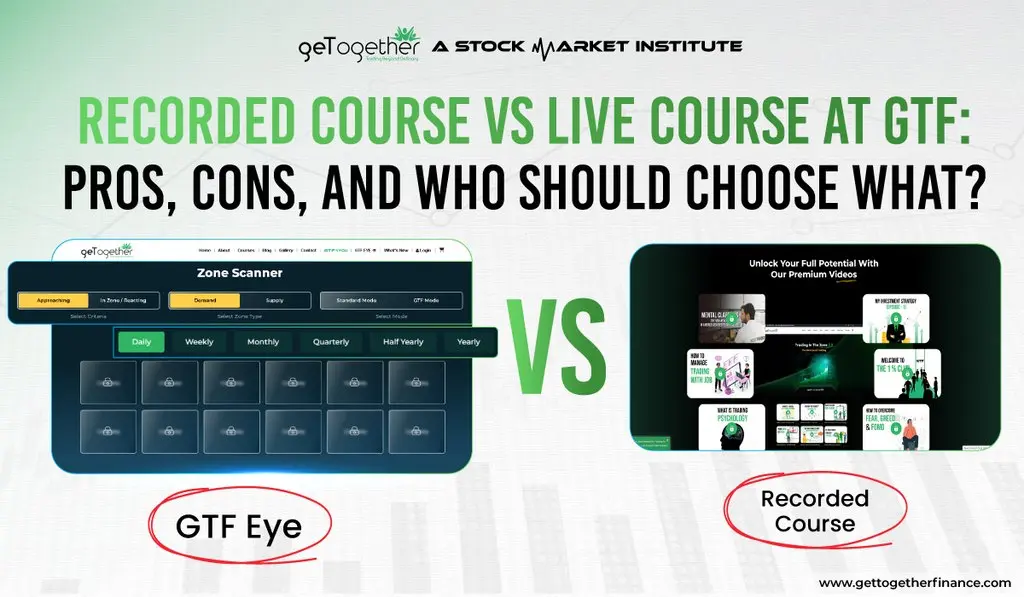
The most important step in a person’s trading journey is choosing the right trading course. These days, most institutes offer both formats, which makes it tough for beginners to pick between the Recorded Course vs Live Course.
Here, the crucial thing you need to understand is that there is no right or wrong option. Some people learn better through live classes with mentors, while others learn better through enjoying the flexibility of recorded lessons.
GTF gives you both options: Trading in the Zone (TIZ) Live and Trading in the Zone (TIZ) Elite. They teach the same trading concepts, but your learning style is what creates the difference between them. In this blog, we’ll explain and compare GTF’s Recorded Course vs. Live Course and help you choose the best one.
Pros and Cons of a Live Trading Course
A live course means experienced mentors teaching you live. You get an interactive classroom to discuss the markets, ask questions, and stay consistent through the process. GTF’s TIZ Live Course offers lifetime mentorship, hands-on training from real mentors, and a trader community.
Here are the pros of a live course:
1. Interactive Learning: In a live course, a student can directly interact with mentors. They can also ask their questions and resolve doubts, which makes learning more engaging and interactive.
2. Better Discipline: Live courses have a fixed class schedule, which encourages students to complete the course instead of postponing lessons. This kind of structure works well for beginners, as they get proper guidance and accountability.
3. Learn from Experienced Mentors: Live sessions connect you with experienced traders who share practical insights instead of just theoretical knowledge. By this, you can get toi know about common mistakes to avoid, different market conditions, and how to apply strategies in real scenarios.
4. Community Support: In live sessions, you can discuss market observations and exchange ideas, which creates a collaborative environment. A trading community also offers encouragement and diverse perspectives that deepen your understanding.
5. Structured Curriculum: A live course follows a well-planned curriculum because each topic builds on the previous one. This helps you develop a strong foundation before moving on to advanced concepts, keeping your learning more organized and effective.
You’ve seen the pros of a Live Course; it also comes with a few limitations. Here are 3 cons to consider:
1. Fixed Schedule: There is a fixed schedule of live classes, which requires adjustment to your daily routine. If you are a working professional or a college student, then it becomes difficult to manage your time.
2. Less Flexibility: Live courses follow a set timetable, which is challenging for learners, especially if you travel often, work rotating shifts, or have an unpredictable routine.
3. Requires Regular Participation: You’ll get the most out of a live course by showing up consistently, asking questions, and practicing what you learn. If you miss multiple sessions or do not participate actively, then it becomes difficult to understand concepts and stay on track.
At GTF, though, students get recordings of live sessions, so they can revisit missed classes and catch up without falling behind.
Pros and Cons of a Recorded Trading Course

For learners who value flexibility and want full control over their pace, a recorded course is the best option. With this, you have full freedom to access the lessons as per your schedule.
GTF’s TIZ Elite course gives you structured, recorded sessions backed by live Q&A support, so you don’t have to choose between convenience and guidance.
Here are the pros of a Recorded Course given:
1. Learn at Your Own Pace: The main benefit that a recorded course offers is flexibility. You can learn from anywhere at any time. This makes it perfect for students, busy professionals, or anyone who has limited time.
2. Replay Lessons Anytime: If a concept feels difficult, you can pause, rewind, and watch multiple times in recorded sessions. This makes learning more comfortable and effective.
3. No Pressure of Fixed Timings: In order to attend a session, you don’t need to rearrange your daily routine. You can learn at your own pace without worrying about missing important classes.
4. Structured Learning Experience: The sessions are recorded, but it follows a structured curriculum. Each module builds on the last, helping you understand trading concepts properly.
5. Suitable for Independent Learners: If you like studying on your own and managing your own schedule, then recorded sessions are the best choice.
You’ve seen the pros of a Recorded Course; it comes with a few limitations, too. Here are 3 cons to consider:
1. Requires Self-Discipline: The main advantage of recorded sessions, that is, flexibility, is becoming its greatest disadvantage. The reason is that it does not have fixed class timings, which easily leads to loss of consistency or session delays.
2. Limited Real-Time Interaction: All lessons are pre-recorded, so you cannot ask questions while watching the videos. Although GTF fixes this gap with live Q&A sessions, learners can directly interact with mentors and get their doubts cleared.
3. Less Classroom Experience: In recorded learning, live classroom experience is missing. It does not offer real-time discussions and learning alongside a batch of fellow traders.
How to Know Which Format Suits You Right Now

There are some important factors, such as lifestyle, learning style, and daily schedule, that you need to consider before choosing between a Recorded Course vs. a Live Course. In this, there is no right or wrong choice; you can pick whichever suits you best.
A Live Course is Right for You If:
- You are a beginner who prefers mentor guidance
- You stay focused when you have a fixed class schedule
- You like interacting with classes and asking questions
- You prefer group learning with peer traders
A Recorded Course is Right for You If:
- You are comfortable learning on your own
- You like the flexibility to study from anywhere and at any time
- You prefer rewatching lessons for better understanding
- You have a busy schedule
If you stay consistent and practice daily, then both formats can help you become a successful trader. At GTF, both the Trading in the Zone (TIZ) Live and Trading in the Zone (TIZ) Elite teach you the same core trading concepts. The main difference is how the course is delivered. So, pick the format that suits your routine and helps you stick with it till the end. SS
How GTF Delivers Learning Through Both Formats

GTF offers a complete and systematic learning path, whether you choose a live course or a recorded course. Both TIZ Live and TIZ Elite cover the same core concepts and are built on the same learning approach.
In both courses, you’ll learn:
- Demand and Supply Trading
- Trading Psychology
- Price Action
- Risk Management
- Market Structure and Trend Analysis
The main difference here is not about what you’re taught, but how it reaches you.
In TIZ Live, you attend live classes where you can interact with mentors, ask questions, solve your doubts, and learn together with peer traders. In TIZ Elite, you can watch recorded lessons anytime, anywhere, and solve your doubts by joining live Q&A sessions.
No matter which format you choose, GTF helps you understand the market, build confidence, and turn your knowledge into real trading decisions.
TIZ Live vs TIZ Elite: A Direct Side-by-Side Breakdown

Both Trading in the Zone (TIZ) Live and Trading in the Zone (TIZ) Elite are built to offer you a structured path into trading. They cover the same core concepts, but the learning experience is what makes the difference. If you’re comparing Recorded Course vs. Live Course, this comparison table of GTF’s TIZ Live and TIZ Elite will help you make the right decision.
| Features | TIZ Live | TIZ Elite |
| Learning Format | Live online classes with mentors | Pre-recorded video lessons |
| Mentor Interaction | Live interaction during classes | Live Q&A sessions for doubt solving |
| Learning Style | In TIZ Live, there is a fixed class schedule | In TIZ Elite, you can learn anytime at your own pace |
| Flexibility | It is less flexible due to scheduled classes | It is highly flexible because you can learn from wherever you want |
| Course Structure | A mentor guides you through each step | Organized recorded lessons |
| Best For | TIZ Live is best for beginners who prefer mentor guidance | TIZ Elite is best suited for working professionals and self-paced learners |
Whichever course you pick, you’ll learn the same trading concepts and build a solid base in the stock market.
Still Unsure? Start with GTF’s Free Elementary Course

If you’re not sure whether to choose Trading in the Zone (TIZ) Live or Trading in the Zone (TIZ) Elite, you can start with GTF’s Free Trading in the Zone–Elementary Course. This will help you understand the basics first. This course covers crucial topics such as trading psychology, demand and supply, stock market basics, risk management, and technical analysis.
The best part is that GTF’s Trading in the Zone–Elementary Course is completely free, which helps you understand the teaching style before choosing a paid course. Wehn you complete this course, it becomes easy for you to decide which learning format suits you properly.
If you like to learn through live classes and interaction with mentors, TIZ Live is a preferable choice. If you prefer to learn at your own pace, TIZ Elite is a good option.
When you start with GTF’s free Elementary Course, it helps you build a strong foundation and choose the right course confidently.
Conclusion
When comparing Recorded Course vs. Live Course, remember that both TIZ Live and TIZ Elite teach the same trading concepts. Your learning style is what creates the difference between them. If you prefer live mentor guidance and interaction, select TIZ Live, and if you want the flexibility, choose TIZ Elite.
If you’re still unsure, start with GTF’s Free Trading in the Zone–Elementary Course. It will help you understand the fundamentals of the stock market and pick whichever format works best for you.
What is the difference between a live and recorded course?
A live course offers real-time mentor interaction, while a recorded course allows you to learn at your own pace.
Which is better for beginners, live or recorded courses?
A live course is better for beginners who prefer mentor guidance and a fixed schedule.
Are recorded courses flexible?
Yes, recorded courses let you study whenever and wherever you want, plus you can rewatch lessons as many times as you need.
Do GTF’s live and recorded courses teach the same concepts?
Yes, both TIZ Live and TIZ Elite cover the same core trading concepts.