
Options Trading for Beginners: A Comprehensive Guide
- Updated on :
- 3381 Views
- by Arun Singh Tanwar

 Facebook
 Instagram
 Youtube
 Linkedin

Options trading offers a fascinating and open door for novices to enter the world of financial markets and possibly benefit from financial outcomes without really possessing the basic resources. Investors can profit from this adaptable and potentially profitable financial instrument in both bullish and bearish markets. This blog will help you understand the concept of option trading if you are new to it.
Options trading for beginners is a type of derivative market in which traders can buy or sell options contracts. Traders can use these contracts to buy or sell an underlying asset at a predetermined price, known as the strike price, within a predetermined time frame, known as the expiration date. However, they are not required to do so.
How Options Trading Works for Beginners
Options trading means buying and selling options contracts based on an underlying asset like stocks, commodities, or indices. An options contract gives the buyer the right, but not the obligation, to buy or sell that asset at a fixed strike price, on or before the expiration date.
There are two basic types: call options, which benefit from a rise in the asset’s price, and put options, which benefit from a decline. Traders can buy or sell either type, depending on their strategy and market outlook.
Selling Put Options: When you sell put options, you give another person the right to sell the underlying asset to you at a certain price within a certain amount of time. You get the premium in return. If the price of the underlying asset remains above the strike price until the contract expires, this strategy will result in profits.
Buying Call Options: Traders can make money by purchasing call options if the price of the underlying asset rises above the strike price before the option’s expiration date. Traders can use this strategy to take part in price rises while only taking on the premium they pay.
Buying Put Options: Traders seek to profit from price declines by purchasing put options. Put options gain value if the price of the underlying asset falls below the strike price before the expiration date.
Selling Call Options: When you sell call options, you give another person the right to buy the underlying asset from you at a certain price within a certain amount of time. You receive the premium in consideration for this obligation. If the price of the underlying asset stays below the strike price until the contract expires, this strategy will make money.
As we have discussed how option trading works, let’s now look at the key advantages options trading can offer beginners.
Advantages of options trading for beginners
Options trading can offer several advantages when used with proper knowledge and risk management. It gives traders flexibility to participate in different market conditions, manage risk, and use strategies based on their market outlook.
- Leverage: Options give you leveraged exposure to the underlying asset, meaning you can take part in price movements by paying a relatively small premium upfront. But remember, leverage works both ways — it can boost gains as well as losses.
- Hedging: Options can help protect existing positions. Strategies like protective puts and collars can shield you from unfavorable price movements.
- Defined Risk: For buyers, the maximum you can lose is usually just the premium paid. Sellers, on the other hand, can face much bigger risks depending on the strategy used.
- Flexibility: You can pick different options strategies based on your market view, risk appetite, and trading goals.
Options trading offers several advantages, but it also involves risks that require careful management. Now let’s look at some key risk management practices.
Risk Management in Options Trading for Beginners
To safeguard your capital and reduce losses, effective risk management is essential in options trading. These practices can help traders make more disciplined decisions and manage their exposure to market risks. Some essential methods are as follows:
- Setting Stop-Loss Orders: By automatically closing out a position when the price reaches a predetermined level, stop-loss orders can help limit losses.
- Risk can be reduced by diversifying your options hedging trades across various calls and puts. Any single trade or market event will have less of an effect on you if you spread out your investments.
- Position Sizing: To effectively manage risk, it is essential to carefully determine the appropriate position size based on your risk tolerance and account balance. With the right position size, you won’t put too much money at risk in a single trade.
After discussing the importance of managing risk in options trading, let’s explore some commonly used options trading strategies.
Options Trading Strategies
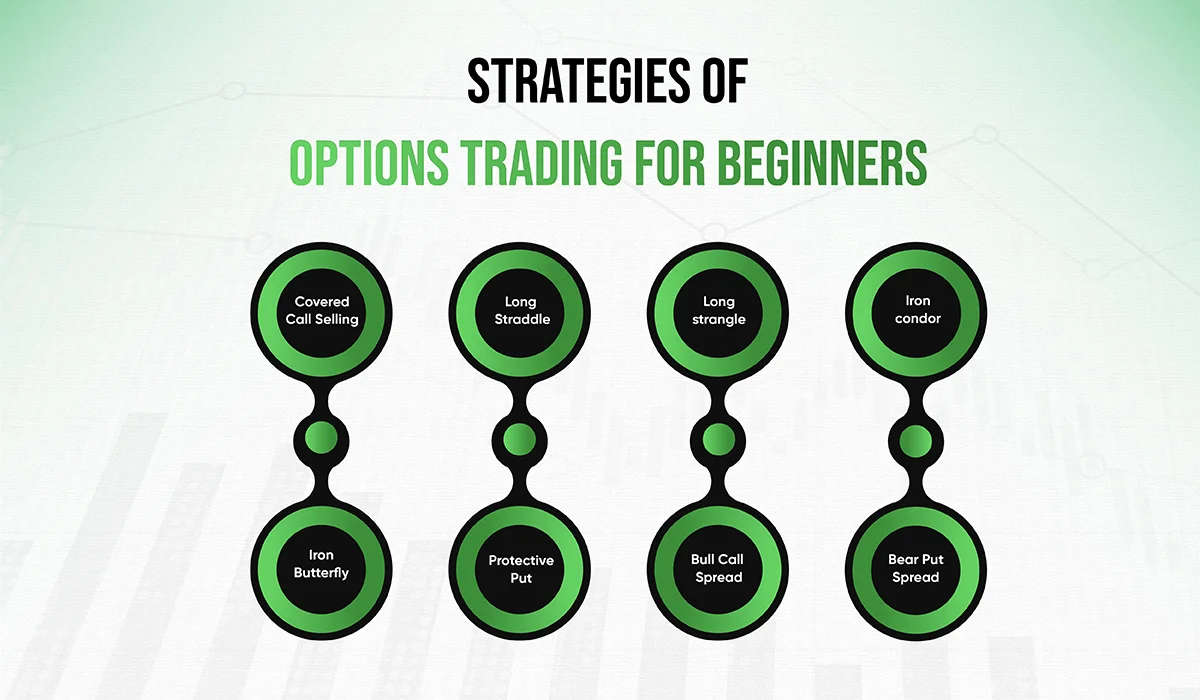
Traders can choose from different options trading strategies depending on their market outlook, risk tolerance, and goals. Understanding how these strategies work can help beginners pick an approach that fits their expectations and risk management plan.
Covered Call Selling
Call options against assets you already own is the covered call strategy. It allows you to profit from the stability or slight price increase of the underlying asset while also generating income from the premium received.
Long Straddle
In a long straddle, you buy both a call and a put option with the same strike price and expiration date at the same time. Regardless of whether the market goes up or down, this strategy makes money when prices go up or down a lot.
Long strangle
The Long Strangle (also known as the Buy Strangle or Option Strangle) is a neutral options strategy. It involves simultaneously buying a slightly OTM Put Option and a slightly OTM Call Option, both with the same underlying asset and expiration date. When the trader anticipates high volatility in the underlying stock shortly, this long-strangle strategy may be utilized. It’s a method with a lot of potential for reward and little risk.
Iron condor
An options strategy known as an iron condor has four strike prices: two calls (one long and one short), two puts (one long and one short), and all of them have the same expiration date. The iron condor makes the most money when the underlying asset closes at expiration between the intermediate strike prices.
Iron Butterfly
The Iron Butterfly is a method for trading options that uses four different contracts to try to make money from the movement of futures and/or options that work within a certain range. Predicting a region at a time when the value of options is anticipated to be on the decline is the key to success with this strategy, which is intended to take advantage of a decrease in implied volatility.
Protective Put
Buying put options on an existing stock position to safeguard against potential downside risks is the protective put strategy. The gains will be compensated for by the put options if the stock price falls.
Bull Call Spread
Buying call options at a lower strike price and selling them at a higher strike price at the same time is a bull call spread. When a moderate price rise is anticipated, this strategy is used.
Bear Put Spread
Buying put options at a higher strike price and selling put options at a lower strike price at the same time is a bear put spread. When a moderate price decline is anticipated, this strategy is used.
These are some commonly used options trading strategies, but there are several other strategies that traders can explore based on their market outlook and risk profile.
Also Read: Bullish Options Strategies
It is important to know different options trading strategies, but beginners should also watch out for common mistakes that can affect their decisions.
Common Mistakes to Avoid When Trading Options for Beginners
Options trading can feel complex for beginners, and not fully understanding it can lead to avoidable mistakes. Knowing these common mistakes in advance can help traders approach the market with more discipline and better risk management.
- Trading Without Understanding the Basics: Options trading comes with its own set of concepts — strike prices, premiums, expiration dates, and different option types. It’s important to get these basics clear before placing a trade.
- Trading Without a Plan: A solid trading plan should spell out your goals, risk tolerance, entry and exit points, and how much position size you’re comfortable with.
- Ignoring Risk Management: Taking trades without thinking about how much you could lose puts you at unnecessary risk. Proper position sizing and risk management matter a lot in options trading.
- Overtrading: Trading too often without a clear strategy can rack up transaction costs and expose you to unnecessary market risk.
- Emotional Decision-Making: Letting emotions like greed, fear, or the urge to recover losses fast drive your trades usually leads to poor decisions.
Conclusion
Options trading for beginners presents an exciting opportunity to investigate the financial markets. You can increase your chances of success in this dynamic trading arena by having a solid understanding of the fundamentals, practicing effective risk management strategies, and continuously learning new things. Keep in mind to start small, diversify your trades, and create a clear trading strategy. Options trading for beginners has the potential to become a valuable addition to your investment portfolio with practice and determination.
FAQs
Q1. Are stocks less risky than options?
When compared to stock trading, options trading for beginners is more complicated and carries more risks. However, options can be used to effectively manage risk with the right knowledge, risk management, and strategy implementation.
Q2. Is options trading for beginners?
Options trading for beginners can be complicated, but beginners can participate with the right education and risk management. It is recommended to begin with a solid understanding of the fundamentals and practice on paper trading platforms.
Q3. Is option trading strategies profitable for novice traders?
Yes, starting with options trading for beginners can be profitable. It necessitates thorough research, a solid understanding of the market, and disciplined strategy implementation.
Q4. What are my options trading strategies?
Your trading objectives, risk tolerance, and market conditions are just a few of the considerations that go into selecting an options trading strategy. Before putting any options trading strategies into action, it is essential to comprehend their characteristics and potential dangers.
Q5. Where can I find additional resources on options trading strategies?
Options trading strategies are covered in detail in a plethora of online resources, including educational websites, books, and courses. Participating in trading communities and interacting with seasoned traders can also yield useful insights.