
Fiscal Policy: Objectives, Pros and Cons
- Updated on : September 12, 2026
- 1760 Views
- by Manaswi Agarwal

 Instagram
 Linkedin
Fiscal Policy is a mechanism used by the government to influence the overall economy of the country. It means the use of spending and taxation to manage the economy, involving decisions related to government revenue and expenditure. These measures are taken to achieve specific economic objectives such as economic growth, price stability, employment, and income distribution. Changes in government spending and taxation can shape consumer demand, business activity, and the overall state of the economy.
In this blog, we’ll look at how fiscal policy works and how it affects the economy and financial markets.
What is Fiscal Policy?
Fiscal Policy is used by the government to promote strong and sustainable growth of the Indian economy. Fiscal policy refers to government spending and taxation to influence the economy. India is a big economy, and hence decisions taken by the government have an enormous impact on such a wide economy. Policies implemented by the government can affect the macro economy and financial markets.
For example, the government can boost spending on infrastructure and public services to support economic activity, while changes in taxation can shape household consumption and business investment. Depending on how the economy is doing, the government may use expansionary fiscal policy to support demand during a slowdown, or bring in contractionary measures to help control inflationary pressures.
Objectives of Fiscal Policy
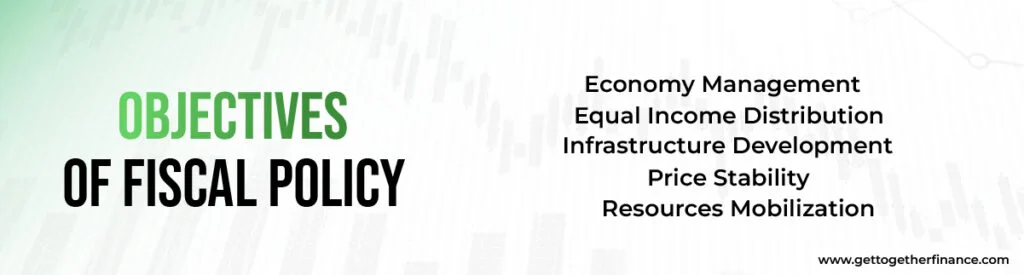
Fiscal policy plays a key role in shaping a country’s economic direction. Governments use different fiscal tools to drive economic growth, maintain stability, and meet broader social and developmental needs. Let’s look at the main objectives of fiscal policy.
Economy Management
The government uses fiscal policy with an aim to stimulate and sustain economic growth by undertaking measures that encourage investment and consumption and boost overall economic activity. To ascertain these several objectives, the government is spending on the country’s infrastructure, education, and healthcare.
Equal Income Distribution
The implementation of fiscal policy or measures such as progressive taxation ensures equal distribution of resources and opportunities among different sections of society.
Infrastructure Development
The objective of using fiscal policy is to increase investments towards critical infrastructure projects for economic development. It helps to increase investments in projects of transportation, energy, and telecommunication to facilitate long term development of the country.
Price Stability
One of the major objectives of using fiscal policy is to control inflation in the economy by maintaining price stability. The policy is also used to leverage money in the market during times of recession in the economy.
Resources Mobilization
The government strives to balance revenue generation through tax or non-tax resources at the same time it ensures that fiscal deficit remains within manageable limits.
Instruments of Fiscal Policy

To bring about change in such a wide economy, there are several tools under fiscal policy through which the government influences economic activity, demand, growth, and price stability. These instruments help the government manage its revenue and expenditure while responding to changing economic conditions.
Government Receipts
The funds received by the government through taxes, interest, investment gains, and payments for services, with the help of which the government is able to finance its activities. Government Receipts are in the form of capital and revenue receipts. Capital receipts are raised through borrowing or selling assets, which are utilized for the capital expenditure of the government.
Revenue receipts are received from direct or indirect taxes to meet the regular expenditures of the government. The government stimulates economic growth by spending the money towards investment while creating more job opportunities.
Taxation
It is an instrument used to manage the flow of money in the economy. Central banks are responsible for adjusting tax rates and tax structures in order to manage the economy. A deduction in tax rates increases disposable income for the consumer, and hence spending as well as investment is increased. Conversely, an increase in taxes results in reducing inflation to stabilize the economy.
Transfer Payments
Transfer payments are a tool of fiscal policy that is utilized by the government to help individuals who are in need by providing unemployment benefits, pensions, and social security. It allows the government to maintain consumption levels while the economy is facing downturns.
Subsidies
Subsidies are given by the government as a form of relief to people belonging below the poverty line. It ensures an equal distribution of resources among different sections of society. Moreover, financial assistance is given to businesses related to the agriculture sector to promote economic activities and stabilize price movements.
Also Read: Monetary Policy
How does Fiscal Policy affect the Stock Market?

Fiscal policy can affect the stock market through shifts in taxation, government spending, and overall economic activity. Any kind of change in tax policies impacts the portfolio of an investor. When corporate taxes are reduced by the government, this will lead to an increase in stock prices as companies will tend to retain more profits, which gives a boost to investments.
On the other hand, higher tax rates can cut corporate profits, which in turn may lead investors to lower their valuation expectations for stocks. Government spending on things like infrastructure can also boost economic activity and benefit the companies working in those areas. But how much this actually affects stock prices depends on overall market conditions, what investors expect, and the kind of policy changes being made.
Importance of Fiscal Policy in India
The government needs to take effective measures in order to control the economic movements in the country. Implementing fiscal policies plays a major role in maintaining price stability as well as controlling inflation.
- During times of inflation, it becomes necessary to implement fiscal policies to control the flow of money and regulate demand as well as maintain price stability.
- Implementing fiscal policies stimulates economic growth by increasing public expenditure and investments into key sectors of the economy.
- The use of fiscal policy also ensures the achievement of social and developmental goals by contributing towards providing quality education, healthcare, transportation, and infrastructure, and fostering inclusive growth.
Challenges and Considerations of Fiscal Policy

Implementing fiscal policies requires good knowledge so that their negative side can also be managed at the right time. Policymakers must be well known about the incorrect implications of fiscal policies, as these can disturb economic activities.
Timing Issues
Government policies need to be implemented at the right time, which can be difficult to judge accurately. This makes it quite challenging for policymakers to decide on the appropriate fiscal measures.
Political Challenges
Political instability can affect fiscal policies, and political interference can lead to delays in decision-making. Various political agendas and election cycles can also push policymakers toward suboptimal decisions focused on short-term gains rather than long-term stability.
Budget Deficit
Increasing government spending and taxes often lead to budget deficits, which can prove to be unsustainable. This might often limit the government’s ability to deal with future economic crises.
Final Thoughts
Fiscal policy is an efficient tool used by the government to maintain economic downturns and to stabilize every movement of the economy. Policymakers efficiently use instruments such as subsidies, taxation policies, and government spending to smoothly run economic activities.
By adjusting these measures based on economic conditions, the government can boost economic activity during slowdowns or ease demand when inflation runs high. Fiscal policy also plays a part in infrastructure development, employment generation, and broader social and developmental goals. However, its effectiveness depends on factors like the timing, scale, and design of the policy measures, along with the prevailing economic conditions.
FAQs
What is Fiscal Policy?
Fiscal Policy is government spending and taxation to influence the economy. These policies are undertaken to regulate economic movements and control inflation as well as economic downturns.
What are the objectives of Fiscal Policy?
The primary objective of fiscal policy is to stabilize price movements in the economy and ensure better employment opportunities for people.
What are the tools of Fiscal Policy?
Government spending, taxation, deficit financing, public expenditure, subsidies, etc. are the main tools of fiscal policy through which the government aims to stabilize economic growth.
How is fiscal policy beneficial for the economy?
Fiscal policy helps in stabilizing prices through taxation and other tools used by the government. These policies maintain aggregate demand in the economy and contribute towards the deficit by drawing down budget surpluses.