
Build Your First Trading Plan After Completing a Stock Market Course in 7 Steps
- Updated on :
- 23 Views
- by Charul Shakya

 Instagram
 Linkedin

Completing a stock market course feels like unlocking a new door to your financial future. In the course, you have learned about candlestick patterns, charts, risk management concepts, and technical indicators, and have gone through live market examples. But for most beginners, the real challenge starts when the course ends.
They can understand the theory, but when it comes to applying it in real life, it becomes difficult for them. Beginners enter the market without having a clear plan. This leads them to rely only on their emotions to make decisions and end up suffering losses. This is the reason why understanding how to make a trading plan is the most crucial step after completing a stock market course.
A trading plan is like a roadmap that leads you to trade the right stocks, manage your risk, enter and exit at the right time, and stay disciplined under pressure. Without it, all your course knowledge is just theory. In this blog, we will guide you on how to make a trading plan that is simple, practical, and beginner-friendly.
Why Most New Traders Fail Even After Completing a Course
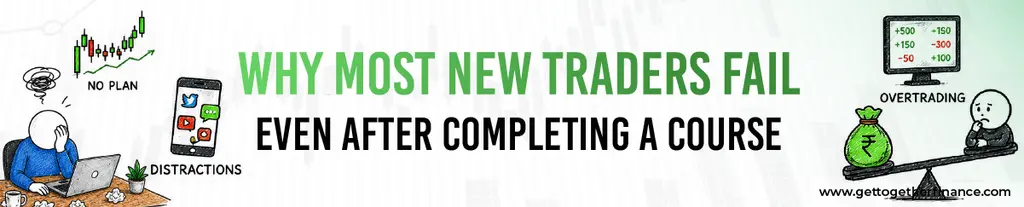
Most people believe that just after completing the course, they start making profits. They feel confident after learning charts, candlestick patterns, trading strategies, and indicators. But when they enter the real market, things become different. And this is exactly where most traders struggle. Learning concepts is only one part of trading; understanding technical analysis does not mean you can apply it properly with discipline. This is actually what happens in the stock market.
A trader completes a course and feels excited to start. They start taking trades based on what feels like a good opportunity. Sometimes they enter too early without proper confirmation, and sometimes they hold losing trades for too long. And from here, confidence starts diminishing, and confusion increases. The main reason behind this is that they don’t have a clear trading plan.
Traders often make emotional decisions when they don’t have a clear plan. They switch strategies after a few losses, take several trades, ignore stop losses, and track market movements without careful analysis.
And after making the same mistakes again and again, they start doubting themselves or even the course they completed. But the problem is not the course. The biggest issue is that most beginners never learn how to make a trading plan that converts their knowledge into disciplined action.
What Is a Trading Plan and Why Is It Non-Negotiable?

A trading plan is a set of guidelines that helps you make better trading decisions. It shows you what to trade, the right time to enter and exit a trade, how much money to risk on each trade, and where to set your stop-loss. Most beginners enter a trade quickly without any proper planning, which leads to heavy losses. A trading plan helps you make logical decisions instead of random ones.
It answers all the crucial questions like:
- How much risk will you take?
- Which market will you trade?
- How will you monitor your performance?
- What strategy will you follow?
If there is no roadmap, then there is no direction, and trading become confusion. That’s why a trading plan is non-negotiable.
If you really want to learn how to make a trading plan, here’s the most important thing to understand. Successful trading isn’t about being in the right place at the right time. But it’s about having a well-structured plan and following it consistently.
Step 1: Define Your Trading Goals
Before you learn how to make a trading plan, the one thing that you should be clear about is why you want to trade. I know this sounds simple, but this one question will determine everything about how your trading story unfolds.
Everybody has their own reasons to start trading. Some want to build long-term wealth, some want an additional source of income, and others dream of becoming full-time traders. There is nothing like right or wrong goals; the thing that matters is how honest you remain with yourself.
For example, if you are doing a full-time job and can only give one hour a day to the market, then selecting aggressive intraday trading is not a good choice. In this case, swing trading could be a better option.
When you have clear goals, it becomes much easier to create a trading plan that actually delivers results.
Step 2: Choose Your Trading Style
Once you know your goals, the next step is to pick the trading style that actually suits you. The best trading style isn’t the one everyone follows, but the one that fits your mindset, schedule, and risk-taking capabilities.
- Intraday trading suits those who can think fast and stay active in the market throughout the trading day.
- Swing trading is for people who prefer flexibility and can hold a trade for several days.
- Positional trading is more appropriate for those who want to invest for the long term.
You need to choose what suits your trading style, not what is trending on social media.
Step 3: Select Your Markets and Instruments
The most common mistake that a beginner makes is trying to trade everything at once: options, stocks, indices, etc. This is confusing; that’s why the best approach is to focus on one thing first and understand it properly.
- If you are new to the stock market, you can start with equity stocks, as it is easy to understand. In this, you learn price movement and market behaviour without any complexity.
- Index trading can be a great choice if you want broad market exposure rather than focusing on individual stocks.
- F&O looks tempting because of fast returns, but it involves huge risk. So, it is advisable to enter into this type of trading by building a strong foundation.
And no matter where you are in your journey, one thing that never changes: the more focused you are, the faster you grow.
Step 4: Set Up Your Entry, Exit, and Stop-Loss Rules
This is the stage where your trading plan gets real. You need to get specific, like exactly when you will enter a trade and exactly when you will get out. Because without clear answers, your decisions will be taken over by emotions.
For instance, you can enter a trade only when a stock clearly breaks through a key resistance level, and the volume is strong enough to confirm that move.
Similarly, you also need to plan an exit. With the help of these rules, you can trade with confidence.
Step 5: Define Your Risk Management Framework
The most important thing that a beginner should take seriously is risk management. Even the most experienced traders incur losses if they do not manage risk properly. First, you have to decide how much risk you can take on each trade. Most traders follow the 1–2% rule, which means never risk more than 1 to 2 percent of your total capital on a single trade.
Also, setting a daily loss limit is important. Once you hit that limit, just stop trading for the day. By following this simple rule, you can protect your capital and control yourself from taking emotionally driven decisions.
Always remember that, more than making a profit, protecting your money to stay longer in the market is essential.
Step 6: Build Your Pre-Market and Post-Market Routine
Every successful trader follows a routine that helps them earn consistent profits. They don’t just open a chart and trade randomly. Such traders follow a well-structured process that covers everything, such as managing risk, studying the market, and planning trades, etc.
In trading, before the market opens, you should prepare yourself, like reviewing important news, spotting important price levels, and making your watchlist ready. And when the market closes, deeply analyze the trade that you took. By incorporating this simple habit in your routine, you improve your decision-making.
Step 7: Start a Trading Journal and Stick to It
A trading journal is one of the most powerful tools that traders use to improve themselves. It identifies your strengths, weaknesses, and patterns in your trading behavior.
After every trade, write down:
- How you felt during the trade
- Why you entered
- What worked
- Why you exited
- What went wrong
With time, journaling gives you useful insights into your strengths, your hidden flaws, and where you can grow. And if you really want to understand how to make a trading plan that works, journaling is non-negotiable. It makes every trade count: win or lose.
Common Trading Plan Mistakes Beginners Make

Building a trading plan is an essential step, but just making it is not enough. Most beginners find it difficult to follow their plan correctly, which leads to losses, confusion, and inconsistency. By understanding these common mistakes, traders can make better trading decisions and follow their strategy more effectively. Here, the good part is that a trader can completely fix these mistakes with the right mindset and method.
Let’s look at some common trading plan mistakes and how traders can avoid them.
Changing Strategies Too Quickly
This is the most common mistake that new traders make. Even after losing two or three trades, they feel that the strategy is not good. Then, the traders continuously switch between different strategies, which increases the confusion.
They can fix this mistake by giving enough time to the strategy, testing it over several trades, and assessing the overall performance.
Risking Too Much on One Trade
Most beginners put a huge amount of money on a single trade in order to gain a higher profit. This might work sometimes, but one bad trade can wipe out your money and damage your confidence.
Setting a fixed limit for every trade can help you reduce your risk. Most experienced trader only put a small portion of their capital on one position to reduce risk.
Making the Plan Too Complicated
Most people think that using too many indicators and rules can increase the chances of success. But in reality, it creates confusion. When your plan is complicated, it becomes very difficult to make quick decisions.
You can fix this mistake by keeping your plan simple. Just follow some basic rules like how to manage risk, when to enter, and when to exit.
Ignoring the Plan During Market Volatility
When the market moves fast, emotions take control. Because of fear, you may exit too early, or in greed, you hold on too long. Also, some traders ignore their stop-loss in the hope that the market will reverse, which leads to losses.
You can fix this mistake by just thinking of your trading plan as a rulebook. When you decide on your entry, exit, and stop-loss, follow them strictly; don’t let emotions change your decisions.
How GTF’s Courses Help You Build a Practical, Real-World Trading Plan

Most traders finish the course but still find it difficult to trade in real life. The main reason is that understanding concepts and actually using them in a live market are two very different things.
This is where GTF’s courses make a difference. They don’t just teach theory but show you how to actually use these concepts in real market circumstances. Through this, you can gain clarity and build confidence. Anyone who wants to understand how to make a trading plan can use GTF to help them put their knowledge into action. Because in trading, success doesn’t come from using more indicators; it comes from having a clear plan and following it with discipline.
Final Thoughts
Completing a stock market course is the first step, but applying that knowledge in the market is where the real learning begins. If you want to understand how to make a trading plan, don’t overthink it. Just select a trading style that suits you, manage your risk properly, be clear about your goals, and monitor your progress. Your trading plan doesn’t need to be perfect, but it needs to guide you and keep you disciplined. When you follow a simple plan with discipline, it helps you succeed.
FAQs
What is a trading plan in the stock market?
A trading plan is a set of guidelines that help traders decide when to enter, exit, and manage trades.
Why is a trading plan important for beginners?
A trading plan is important for beginners as it helps them trade with discipline and avoid emotional decisions.
Can I trade without a trading plan?
Yes, you can, but trading without a plan often leads to losses, confusion, and mistakes.
How much risk should a beginner take per trade?
Most experienced traders advise taking only 1–2% risk of total trading capital per trade.
How do I make my first trading plan?
You can make your first trading plan by defining your goals, setting risk limits, choosing a trading style, and creating clear entry-exit rules.
How do GTF courses help in building a trading plan?
GTF courses give you practical market knowledge that makes it easier to build your own systematic trading plan and follow it with confidence.
Which trading style is best for beginners?
Swing trading is considered best for beginners because it gives them more time to analyze the market and make decisions calmly.