
Net Asset Value (NAV): Definition, Formula, Example, and Uses
- Updated on :
- 2599 Views
- by Suhani

 Instagram

Introduction
Net Asset Value is the per-unit value of a fund’s assets after deducting its liabilities. NAV is commonly used in assessing mutual funds and ETFs; it is calculated by dividing the net assets of the fund (assets minus liabilities) by the number of outstanding units. With this, investors can get an overview of the fund’s value at a specific point in time.
Understanding the dynamics of NAV is crucial for investors as it helps in knowing the value of their investments in mutual funds and ETFs they have chosen. It serves as a valuable metric for making informed investment decisions, allowing investors to keep track of their investment’s value. Moreover, Net Asset Value is a useful metric when comparing different mutual funds and ETFs, but it should not be used alone to assess their growth potential or future performance.
What is NAV (Net Asset Value)?

Net asset value is the metric that helps in knowing the per-unit value of the fund’s assets after deducting its liabilities. It is calculated by subtracting the liabilities of the fund from its total assets and then dividing the outcome by the outstanding units of the fund. It is calculated at the end of each trading day for mutual funds and ETFs. It is calculated based on the closing market prices of the securities (holdings of mutual funds). The NAV helps the investor know the value of their investment at the end of each day.
How NAV is Different from Market Price
The Net Asset Value (NAV) of a fund or ETF represents the per-unit value of its net assets, while the market price is the price at which the ETF is traded on the stock exchange. For mutual funds, investors generally buy or redeem units at the applicable NAV. But it is not the same with ETFs. In an ETF, the market price can differ from the NAV due to supply and demand dynamics because ETFs are traded live on stock exchanges.
An ETF’s trading price may be higher (above NAV) or lower (below NAV), depending on investor mood, liquidity, and market conditions. Understanding this distinction enables investors to make more informed trading decisions and determine whether they are buying or selling at a reasonable price.
Formula for Calculating NAV (Net Asset Value)

The formula for calculating NAV is quite simple; here it is:
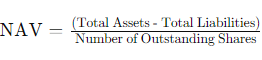
Now let’s understand its terms:
Total Assets: This comprises the current market value of all the holdings of the fund and cash held by the fund.
Total Liabilities: This comprises the fund’s obligations, such as fees, expenses, and any other debts.
Number of Outstanding Shares: The total number of shares that investors have in the fund at a given point in time.
Let’s understand this with an easy example:
Let’s assume a case of a fund where:
Total Assets: ₹50,00,00,000 (₹50 crore)
Total Liabilities: ₹5,00,00,000 (₹5 crore)
Number of Outstanding Shares: 10,00,000 (10 lakh)
Using the NAV formula:

Next, we need to divide the net assets by the number of outstanding shares.
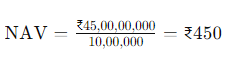
Now, we can say that NAV per share is ₹450, implying that each share of the mutual fund is valued at ₹450, giving investors a clear understanding of the valuation of their investment.
Know This: You don’t need to calculate NAV every time you go for selling or buying the funds; it is automated in online brokers.
After discussing NAV and its formula, let’s understand how NAV works specifically in mutual funds.
Mutual Funds and Net Asset Value

Mutual Funds are pooled investments by multiple investors to invest in a diversified portfolio of securities like stocks, bonds, or other assets. Investors hold units of the mutual fund, which represent their proportional share in the fund’s portfolio.
NAV represents the per-unit price of a mutual fund and is used to determine the value of one share or unit of the fund. It is calculated by dividing the fund’s net assets, after deducting liabilities, by the total number of outstanding units. NAV shifts in response to changes in the value of the fund’s securities, as well as expenses and distributions. It helps investors monitor the value of their mutual fund units.
With the basics of how NAV works in mutual funds covered, let’s explore why NAV matters to investors tracking and evaluating their fund investments.
How is the Net Value of an asset relevant for investors?

Net Asset Value (NAV) is highly relevant for investors in mutual funds because it supports decision-making. It plays a role in analysing how mutual fund units are priced, tracking their performance, and valuing the portfolio. NAV serves as a benchmark for comparing mutual funds and helps investors understand their investment’s current worth. It’s a helpful tool for evaluating a fund, but investors shouldn’t base their decision on it alone.
Investors should also consider the fund’s returns, expenses, risk, investment strategy, and portfolio holdings. Investors should also consider the fund’s returns, expenses, risk, investment strategy, and portfolio holdings. When these factors are considered along with NAV, investors better understand a mutual fund and make more informed choices.
NAV shows investors the current value of their mutual fund units, and it also helps track how a fund’s value changes over time. Let’s look at how NAV factors into evaluating fund performance.
Role of NAV in the performance of a Fund

Net Asset Value (NAV) plays a crucial role in understanding and evaluating the performance of a mutual fund. It helps investors track changes in the value of their investment and assess a fund’s performance over time. Some important roles of NAV include:
Indicator of Growth: NAV allows investors to monitor how the value of their mutual fund units changes over time.
Basis for Calculating Returns: NAV is used to determine the returns generated by a mutual fund investment over a set period.
Reflects Portfolio Management Efficiency: Changes in NAV can help investors understand how the fund’s portfolio has performed over time.
Determines Investment Value: It shows the current value of an investor’s mutual fund units.
Not the sole measure of performance: Since NAV alone doesn’t indicate a fund’s performance, investors should look at other factors too.
Transparency for Investors: NAV allows investors to know what each fund unit is currently worth.
NAV not only helps investors track their fund units’ value and performance, but also determines the price at which units are allotted or transferred across different mutual fund transactions.
NAV Allotment for Different Investment Types

Net Asset Value (NAV) allotment process varies for different types of mutual fund investments, such as lump-sum investments, Systematic Investment Plans (SIPs), and Systematic Transfer Plans (STPs). For lump-sum investments, the applicable NAV depends on when the investment request and funds are received, as per the applicable rules.
With SIPs, each instalment is invested to buy units at the NAV applicable on the respective transaction date. In STPs, units move from one scheme to another based on the applicable NAV of each scheme. Therefore, it is important to understand the applicable NAV. It helps investors know how many units they get or transfer, regardless of the investment method.
To understand why NAV matters in practice, it helps to see how it’s applied across different investment methods. With that in mind, let’s look at the key ways investors and mutual funds use NAV.
Uses of NAV

NAV helps investors understand the fund’s current per-unit value and track how their investment is performing. It also plays a role in investment decisions, performance tracking, tax calculations, and reinvestment of distributions. Net asset value helps investors in various ways; here’s the detailed take on uses of NAV:
Valuation of Mutual Funds: Net Asset Value serves as an important component in mutual funds because it serves as a parameter to know the per-unit value of a mutual fund. It is calculated at the end of each trading day to provide the value of the fund. Investors use this to know the value of their investments, eventually helping them make investment decisions. When purchasing or redeeming mutual fund units, transactions are generally carried out at the applicable NAV, subject to the applicable rules. This helps provide a consistent basis for valuing mutual fund units.
Helps in Tax Reporting: Tax reporting is eased by the NAV of a mutual fund because NAV gives a clear valuation of the fund’s units at a specific time. This helps investors calculate their capital gains or losses when they buy or redeem fund units, supporting accurate details for tax filing. It also helps in tracking the value of the investment and determining the gains or losses related to fund transactions.
Dividend Reinvestment Plans: NAV plays a role in dividend reinvestment plans by determining the value at which additional units are allotted when distributions are reinvested. When a fund announces a distribution, the amount may be used to buy more units at the applicable NAV. Reinvestment can increase the number of units held by an investor, which may help build the investment over time.
Also Read: Return on Equity
After discussing uses, let’s understand factors affecting, limitations, and common misconceptions of NAV.
Factors Affecting NAV

A mutual fund’s NAV can change based on movements in the value of its underlying investments and the expenses it incurs. Investors should also consider the fund’s returns, expenses, risk, investment strategy, and portfolio holdings. Some of the key factors affecting NAV are:
Market Fluctuations
The market value of underlying assets or a fund’s holdings is impacted significantly by market fluctuations, eventually impacting NAV. A rise in stock prices increases the NAV; conversely, when these prices fall, the NAV decreases. This makes NAV susceptible to sudden market movements and changes in the value of the fund’s underlying investments.
Impact of Dividends
Dividends or distributions lower the NAV when they are paid out. When the fund pays out a dividend or distribution to its investors, its overall NAV decreases. Consequently, the NAV also drops by the amount distributed per unit. This reduction, however, does not necessarily reduce the investor’s overall value by the same amount, as the distribution is received separately or may be reinvested, depending on the option chosen.
Expenses and Fees
Expenses and fees, such as administrative costs, management fees, and other operating expenses, reduce the NAV. This is because these costs are deducted from the assets of the fund, lowering the total asset value and, consequently, the NAV. High expenses can reduce the returns available to investors over time.
Limitations of NAV

While NAV is useful for understanding the current per-unit value of a mutual fund, it has certain limitations. NAV by itself doesn’t reveal much about a fund’s future performance, market conditions, or tax impact. By understanding these limitations, investors can use NAV more effectively when evaluating their investments.
End-of-Day Calculation: NAV is only updated after the trading session ends; it is not reflected during the live market.
Future Potential: NAV doesn’t help in assessing the future growth of the fund or ETF.
Market Price Deviations: For ETFs, NAV can differ from actual market value because of the demand and supply forces involved in live trading.
Tax Implications: NAV does not provide information on the tax implications of fund distributions and does not give an overview of the fund’s overall tax efficiency.
Expense Consideration: NAV only reflects the current value of the assets or security; it doesn’t account for future expenses or fees that could impact returns on the fund or ETF.
Non-Market Factors: Non-market factors such as economic conditions, geopolitical events, and investor sentiment that may have an impact on fund performance are not included in NAV.
Common Misconceptions About NAV

There are several common misconceptions about NAV that mislead investors about a fund’s true value or performance. NAV is helpful for knowing a fund’s value per unit, but investors shouldn’t base their evaluation on it alone. Here are a few common misconceptions about NAV.
High NAV always means expensive funds: A higher Net Asset Value is never associated with an expensive fund or a fund with exceptional performance. It simply shows the value per share in the fund.
Comparing NAVs helps in Assessing Funds: Only comparing NAVs of the funds based solely on it is not an ideal method. Investors should compare the percentage returns of the fund over the same period to get a good overview.
Future Performance is Associated with NAV: Past NAV or current NAV does not imply anything about the future performance of the fund. Investors should look at other factors: fund management, the fund’s past performance, the sector it is associated with, and most importantly the holdings (stocks or securities) of the fund and the market conditions.
Low NAV does not mean a poor fund: Low NAV does not imply the fund is performing badly; it may be due to volatile or recessionary market conditions. Check all other fundamentals well before investing.
Conclusion
NAV, or Net Asset Value, is a metric of mutual funds that helps assess the per-share value of their holdings. It is used to gauge the overall performance of the fund for a particular day. However, many people misinterpret NAV, believing it helps in assessing future growth potential or the market price of the mutual fund, which leads to poor investment decisions.
It’s important for investors to remember that NAV only represents the per-share value of the fund’s holdings, which helps investors understand the current value of their shares. It does not help in predicting future performance in any way. Investors need to understand that NAV is only for knowing their actual investment value; using it for other purposes may hinder their informed investment goals.
FAQs
What is Net Asset Value (NAV) and why is it important?
Net Asset worth (NAV) is the per-share worth of a fund’s assets less its liabilities. It is critical for investors because it provides a correct assessment of their mutual fund and ETF investments, allowing them to make better decisions and track performance.
How is Net Asset Value different from the market price of a fund?
Net Asset Value is the intrinsic value of a fund’s shares as calculated at the end of each trading day. The market price, on the other hand, represents the current trading price of the fund’s shares on the stock exchange, which might fluctuate throughout the day, particularly for ETFs.
How do dividends and distributions affect NAV?
When a fund pays out dividends or distributions, the overall value of its assets falls, resulting in a decline in NAV. This, however, has no effect on the overall value of an investor’s holdings because the dividend is paid in cash or through reinvestment.
What factors can cause NAV to fluctuate?
NAV may vary owing to market volatility, changes in the value of the fund’s underlying assets, dividend and distribution distributions, and the deduction of expenses and fees from the fund’s assets.
Are there any limitations to using NAV as an investment metric?
Yes, NAV is limited in that it is determined only at the end of the trading day, does not reflect real-time market conditions, does not account for future growth potential, and is impacted by non-market factors such as economic conditions and investor sentiment.