
Piercing Pattern Candlestick: Definition, How to Trade & Real Examples
- Updated on : August 7, 2026
- 6242 Views
- by Arun Singh Tanwar

 Facebook
 Instagram
 Youtube
 Linkedin
As India’s growth story has picked up pace, people are experimenting with investments that were not conventionally followed in this part of the world. Just a couple of decades ago, stock markets were a thing of the elite. But over the years, the masses have broken through the shackles and started investing in the Indian stock markets.
While equity investments provide good returns and liquidity, they involve high risk. However, there are tools like fundamental & technical analysis used by investors to minimize risk in the stock markets. One such technical analysis tool is “Piercing Pattern”. Keep reading to learn how you can use this tool to your advantage!
What Is a Piercing Pattern?

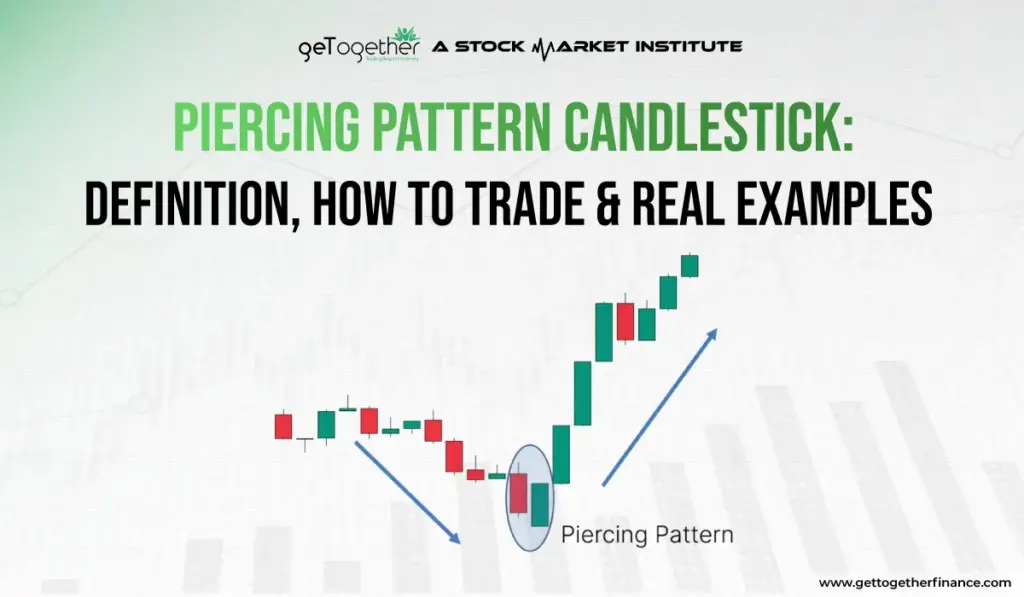
As the name suggests, a piercing line pattern refers to a candlestick formation that shows the effect of piercing through an ongoing trend to reverse it. It can be both bullish & bearish depending on the preceding trend.
Bullish Piercing Pattern
So, here’s the definition of a bullish piercing pattern:
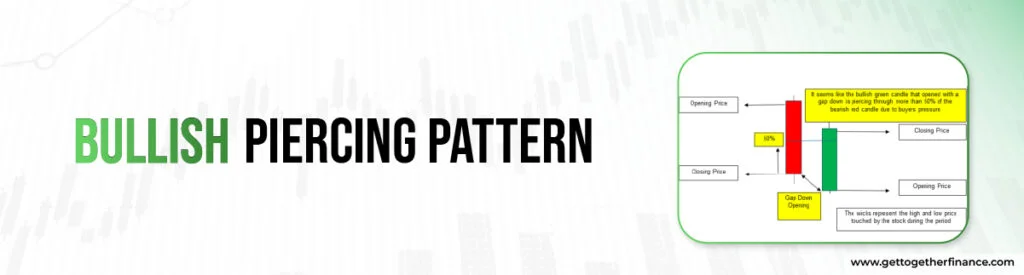
In an ongoing bearish trend, 2 consecutive candles are formed such that:
- The first candle is bearish
- The second candle is bullish and shows the following:
- A Gap down opening from the close of the first candle, and
- The price closes above the midpoint of the bearish candle, i.e. above 50%
The following image represents a bullish piercing pattern.
Red Candle: A bearish candle with a lower closing price than the opening price.
Green Candle: A bullish candle with a higher closing price than the opening price.
Bearish Piercing Pattern (Dark Cloud Cover)

It is the polar opposite of the bullish pattern. So, here’s the definition of a bearish piercing line pattern:
In an ongoing bullish trend, 2 consecutive candles are formed such that:
- The first candle is bullish
- The second candle is bearish and shows the following:
- A Gap up opening from the close of the first candle, and
- The price closes below the midpoint of the bullish candle, i.e. below 50%
The following image represents a bearish piercing line pattern.
Also Read: Tweezer Bottom Pattern
How to Read a Piercing Pattern: Bullish vs Bearish Comparison
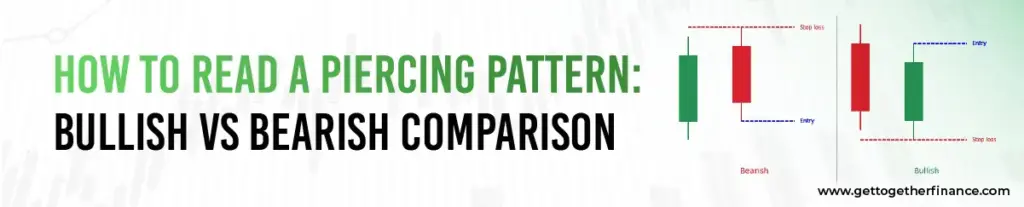
Before trading the piercing pattern, traders must understand what it signals. A bullish piercing pattern suggests increasing buyers’ demand, whereas a bearish pattern (dark cloud cover) shows increasing sellers’ dominance. Traders can easily detect possible market reversals if they understand the difference between these two.
| Basis | Bullish Piercing Pattern | Bearish Piercing Pattern |
| Market Trend | Forms after a downtrend | Forms after an uptrend |
| First Candle | Large bearish (red) candle | Large bullish (green) candle |
| Second Candle | Bullish (green) candle | Bearish (red) candle |
| Opening of Second Candle | Opens below the previous candle’s low or near the gap down | Opens above the previous candle’s high or near the gap up |
| Closing of Second Candle | Closes above the midpoint of the first candle | Closes below the midpoint of the first candle |
| Volume Confirmation | Higher volume on the second candle confirms the bullish signal | Higher volume on the second candle confirms the bearish signal |
| Reliability | More reliable near support levels and oversold conditions | More reliable near resistance levels and overbought conditions |
| Trading Opportunity | After confirmation, traders seek buying opportunities | After confirmation, traders seek selling opportunities |
| Market Psychology | Initially, sellers dominate the market, but buyers enter aggressively and take control | Initially, buyers dominate the market, but sellers step in strongly and push the price down |
| Stop-Loss Placement | Below the low of the pattern | Above the high of the pattern |
| Indicates | Potential bullish reversal | Potential bearish reversal |
How Does a Piercing Pattern Work? Entry, Stop Loss & Target

After a price drop, the piercing pattern gives an early signal that the trend may reverse upward. It’s how the demand of buyers increases, which moves the price higher. Traders need to wait for the price to break above the second candle for confirmation before entering a trade. In order to manage risk properly, they placed a stop loss below the low of the pattern. Traders can set their profit target at the next resistance level or aim to double the profit as a risk. Also, before entering a trade, they look for confirmation from trading volume, higher support levels, or technical indicators like RSI and moving averages. This helps them to increase their accuracy.
Piercing Pattern Formation: Step-by-Step Structure

The piercing pattern appears after the price falls and suggests that buyers are trying to take control. It is made up of two candles that show sellers are losing control and buyers are coming.
There are some steps given below that tell you how piercing patterns form:
Step 1: The market is moving down because sellers dominate.
Step 2: A big red candle form, which shows sellers strongly push the price down.
Step 3: The next candle starts at a lower price, which shows that sellers are still active.
Step 4: Buyers enter the market and push the price higher.
Step 5: The second candle closes above the midpoint of the first bearish candle, which signals that buyers are stepping in.
Step 6: Traders don’t enter the market directly; they wait for
Where Does the Piercing Pattern Appear? (Markets & Timeframes)

There are different markets (cryptocurrencies, stocks, commodities, indices, and forex) in which piercing patterns appear. Generally, it forms after a downtrend and indicates a potential bullish reversal. Also, this pattern can be used on several time frames, such as monthly, intraday, weekly, and daily charts.
Piercing Pattern for Intraday Trading
Intraday traders identify the piercing pattern on short timeframes like 5-minute, 15-minute, or hourly charts to find potential buying opportunities. If the piercing pattern appears after a short-term decline, it indicates that buying pressure is increasing and the price will move higher. Before entering a trade, traders always wait for the price to move above the high of the second candle. Also, in order to manage the risk, they place a stop loss below the pattern.
Piercing Pattern for Swing Trading
Swing traders use the piercing pattern because they hold stock for a long term, such as days or weeks. They generally use this pattern on daily or weekly charts, where signals are usually more accurate. When the piercing pattern forms, it suggests that the price is moving higher. By using support and resistance levels, volume, or technical indicators, traders can confirm the pattern before entering a trade.
How to Trade the Piercing Candlestick Pattern: Practical Steps
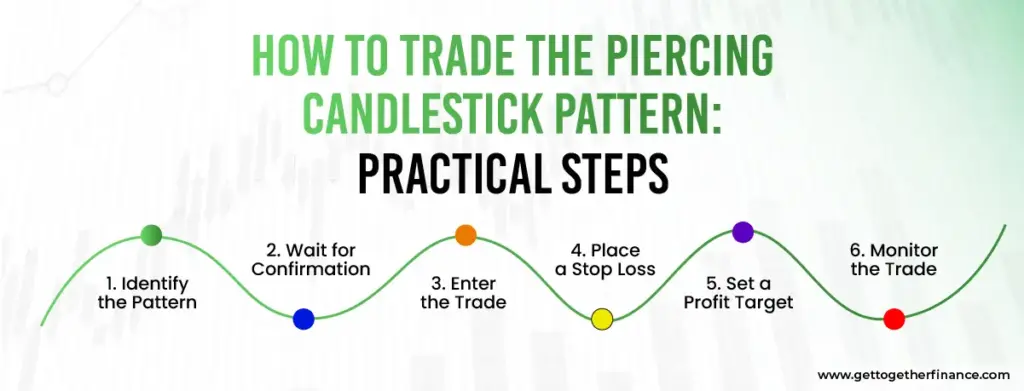
The piercing pattern creates a buying opportunity because it shows that the price tends to rise after a downtrend. You have to follow these steps properly in order to trade this pattern:
1. Identify the Pattern: Always remember that a piercing pattern appears after a downtrend. In this, first, the bearish candle forms, and after it, the bullish candle forms, which closes above the middle of the first candle.
2. Wait for Confirmation: Traders need to wait for proper confirmation before entering a trade. These confirmations include checking the price to move above the high of the second candle or the trading volume.
3. Enter the Trade: After confirmation, traders can enter a trade to buy stocks.
4. Place a Stop Loss: It is essential to manage risk by placing a stop loss below the low of the piercing pattern. This helps you minimise your losses if the price moves in the opposite direction.
5. Set a Profit Target: Set your profit target near the next resistance level, or you can also use a risk-reward ratio like 1:2, where your profit is twice the risk.
6. Monitor the Trade: Always monitor the trade and adjust the stop-loss to book a profit.
How to Find Piercing Patterns Using Stock Screeners

A stock screener is basically a tool that assists traders in filtering out stocks based on certain criteria, like volume, price movement, technical patterns, or trends. Also, it allows them to quickly find piercing patterns without checking each chart manually.
Steps to Scan for Piercing Patterns on a Screener
There are some steps that traders take to scan for a piercing pattern on a screen, which are given below:
1. Select Market and Timeframe: First, choose the market you want to analyze, such as crypto, stocks, or forex, and select a timeframe like daily or intraday.
2. Apply Candlestick Pattern Filter: Then, apply the candlestick pattern filter, and when the piercing patterns appear, pick them.
3. Set Trend Condition: Now, shortlist the stocks that are in a downtrend, because this pattern forms after a price decline.
4. Add Volume Filter (Optional): Additionally, you can check volume to find more reliable trading signals.
5. Run the Screener: Once filters are applied, start the screener to get a list of stocks where piercing patterns are appearing.
6. Verify on Chart: At the end, open the charts and double-check the setup before trading.
Piercing Line vs. Dark Cloud Cover
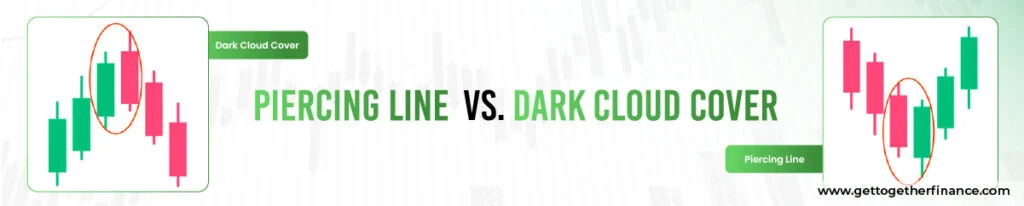
| Piercing Line | Dark Cloud Cover |
| Bullish Reversal Pattern | Bearish Reversal Pattern |
| Bullish Second Candle | Bearish Second Candle |
| Indicates a shift from bearish to bullish sentiment | Suggests a shift from bullish to bearish sentiment |
| Occurs after a downtrend | Occurs after an uptrend |
Piercing Pattern Success Rate

The piercing pattern is a reliable bullish reversal pattern. However, it is not always accurate and does not guarantee that the price will continue to go higher. This pattern is more effective after a strong downtrend and at key support levels. In these cases, a reversal is more likely to happen, but the pattern may fail in sideways or weak market conditions.
If traders want to improve their accuracy, then they look for confirmation, such as:
- RSI shows oversold conditions
- High trading volume
- Price breaking above the second candle’s high
- Support levels on the chart
Also, the piercing pattern is more reliable on daily or weekly charts as compared to smaller intraday timeframes.
Advantages and Disadvantages of Piercing Pattern Candlestick

| Advantages | Disadvantages |
| Easy to Identify | False Signals (Whipsaws) |
| Potential for Significant Profit | Requires Confirmation |
| Works Well in Overextended Markets | Not Effective in Strong Trends |
| Versatility | Short-Term Nature |
| Clear Reversal Signal | Risk of Overtrading |
Piercing Pattern Chart Examples (NSE/BSE Stocks)

Let’s understand the piercing pattern with one example each from NSE and BSE stocks:
NSE Example: Tata Motors
Now, assume that Tata Motors has been decreasing for a few days. One day, a strong red candle forms, which signals that the seller dominates the market. The next day, the stock opens slightly lower, but then buyers come and move the price higher. It closes above the middle of the previous candle, which forms a piercing pattern.
BSE Example: Infosys
Now, again, assume that Infosys is also falling for a few days. One day, it forms a large red candle, indicating growing seller’s domination in the market. The next day, the price drops, but buyers come and again move it upward. Also, the second candle closes above the midpoint of the first candle, which forms a piercing pattern.
Is the Piercing Pattern Bullish or Bearish?
The piercing pattern is a bullish reversal pattern that appears after a downtrend, which indicates the growing demand of buyers. It generally appears with two candles. The first candle is bearish, showing sellers’ control in the market. The other candle is bullish, which closes above the middle of the first candle, suggesting the buyer steps in.
Common Mistakes in Piercing Line Pattern

Here are some common mistakes that traders make with the piercing line candlestick pattern:
- Trading it Without a Support Zone
Several traders take trades even when the pattern is created in the middle of a trend. Moreover, a strong support or demand zone usually causes the pattern to fail.
- Confusing Piercing Patterns with Bullish Engulfing
A candle that covers only a part of the previous bar is usually wrongly treated as a full engulfing pattern by traders.
- Entering Without Confirmation
Entering the trade just immediately after the bullish candle forms is very risky.
Always look for confirmation, such as:
- RSI Oversold
- EMA or support bounce
- Break above the pattern high.
- Bullish divergence
- Ignoring the 50% Rule
When the bullish candle fails to reach beyond the halfway mark of the bearish candle, traders wrongly consider it a piercing pattern.
- Not Checking Volume
Entering without checking volume often results in unreliable setups. A piercing pattern with low volume signals that buyers are not fully participating.
- Ignoring Market Trend Context
Some traders believe that the pattern will always reverse the market. In a strong downtrend, the piercing patterns may lead to a short-lived upward move instead of a complete trend reversal.
- Placing Stop-Loss Incorrectly
Most of the traders place the stop too close to the candle. The stop-loss has to be placed under the pattern’s lowest point to avoid being taken out by sudden price moves.
Pro Tip: Piercing candlestick patterns becomes powerful when it aligns with momentum, support, and volume indicators. A pattern alone is not an indication–confirmation is the main key.
Piercing Pattern vs Engulfing Pattern: What’s the Difference?
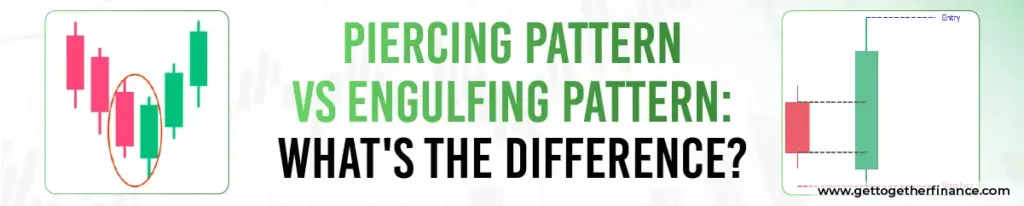
Let’s understand the difference between the piercing pattern and the engulfing pattern from the table below:
| Feature | Piercing Pattern | Engulfing Pattern |
| Formation | Two candles | Two candles |
| First candle | Strong bearish candle | Small bearish candle |
| Second candle | Bullish candle closes above the center level of the first candle. | The bullish candle completely overlaps the first candle. |
| Strength of signal | Moderate | Strong |
| Trading Signal | Buyers are becoming more active | Buyers are dominating the market |
| Buyer control | Partial | Full |
| Reliability | Medium | Higher |
Key Takeaways: Piercing Pattern Explained

Piercing pattern is a bullish pattern that forms after the price goes down. It shows that sellers are losing strength and buyers are getting active. The piercing pattern is made of two candles: the first is bearish and the second is bullish. However, the pattern is not always accurate; that’s why, before entering a trade, traders always wait for confirmation, like a breakout or higher volume.