
What is Intraday Trading: Expert Tips and Mistakes to Avoid
- Updated on :
- 3490 Views
- by Arun Singh Tanwar

 Facebook
 Instagram
 Youtube
 Linkedin
Every investor or trader dreams of minting huge profits in the stock market, following the footsteps of stalwarts like Rakesh Jhunjhunwala or Warren Buffet. However, only a few actually manage to enjoy the gravy train.
Intraday trading – or day trading – is gaining significant momentum if you want to eke out a livelihood from the stock market. However, negotiating this space can get overwhelming for beginners with lots of technicalities involved. To smoothen this journey, this comprehensive guide discusses intraday trading basics and suggests crucial tips and mistakes to avoid throughout the trading day.
What is Intraday Trading?
Intraday trading involves buying/selling financial assets and securities during market hours on the same day. Day traders predict and earn profits from intraday price changes in assets, including stocks, bonds, exchange-traded funds (ETF), and commodities.
The primary objective of intraday trading is to make quick money and exit your position as soon as possible. Additionally, the holding time for assets can vary between some minutes to a few hours.
Generally, day traders scout for high beta stocks, whose prices fluctuate frequently on a regular basis. So, for instance, if a stock price is likely to climb, day traders buy low and sell high. Contrarily, if it is expected to drop, day traders decide to short-sell – selling high and buying low. Indeed, intraday trading demands an acute sense of how the stock market could behave and take action accordingly.
Also Read: Art of Trading Set Up
7 Critical Strategies to Follow For a Successful Trading Day

While intraday trading may bring lucrative financial gains to people, it also results in huge losses if done without keeping up with market rules.
Here are seven pro tips to add to your intraday trading playbook:
1. Set Clear Trading Goals
Before selecting stocks, it is essential to set your trading goals and build a solid intraday trading strategy. Decide which small or large stocks, particular industries, or technical indicators you want to focus on. Furthermore, establish profit targets as daily/weekly/monthly income goals.
2. Pick Liquid Stocks
Choose large-cap and mid-cap equities with high liquidity based on your preferences and risk appetite. These scripts have a high trading volume and tight bid-ask spreads. Hence, their liquidity ensures that your buy/sell orders get executed promptly and at reasonable prices.
So, identify stocks that are actively traded, frequently make it to the news, or are part of prominent bourses.
3. Freeze Realistic Entry and Exit Prices
Intraday trading runs on the ongoing market trend. Hence, use fundamental and technical analysis, or a combo of both, to identify potential breakouts or breakdowns as well as support and resistance levels. Determine your risk-reward ratio as well as stop-loss and take-profit levels accordingly.
4. Monitor Market-related News and Events
Closely follow market news and events that significantly affect share prices. Keep tabs on interest rate changes, companies’ financial reports, geopolitical news, and industry developments. In addition, you can browse financial websites or news aggregators for up-to-the-minute information. Such major events trigger short-term price fluctuations and trading opportunities.
5. Grow One Step at a Time
As a rookie intraday trader, a few successful trades might have put you on cloud nine, but it is still too soon to celebrate. Do not make aggressive bets initially. Instead, pick a maximum of 2-3 stocks to start with and increase the trade volume and value as you gain skills and confidence.
Starting small will let you learn from mistakes and understand market dynamics, so you avoid repeating the mistakes.
6. Do Not Go Broke
Always remember Warren Buffet’s mantra: “Do not put all eggs in one basket.”
You will suffer some losses throughout your trading journey. So, only invest a small fraction of your trading capital in each trade. Define a maximum loss limit for each trade or day, also called risk percentage or risk per trade, to prevent considerable losses.
Leverage trailing stop-loss orders to book profits as the trade goes in your favor. Further, implement position-sizing techniques to control your trade size or volume. Intraday trading is risky; as such, invest only what you can afford to lose.
7. Learn and Adapt
Keep a record of all your trades – both successful and unsuccessful – including the motive behind each trade and the outcomes. Regularly analyze them, identify patterns, learn from your mistakes, and refine your stock selection in real time accordingly.
Intraday Trading Rules Every Trader Must Follow

Here are some important intraday trading rules that every trader must follow:
Use Stop-Loss in Every Trade
In trading, capital protection always come first than making a profit. Lots of traders fail not because of not using strategies effectively, but because they refuse to cut their losses.
Avoid Overtrading
More trading does not mean more profit. A few good trades give you better returns compared to the average ones. Moreover, overtrading led to impulsive decisions.
Trade Only in Liquid Stocks
Always choose stock with high trading volume and have tight bid-ask spreads because they are easier to sell and buy without losing money.
Maintain a Trading Journal
Keep a record of every trade:
- Reason for entering
- Reason for exiting
- Outcome
- Lessons learned
For a trader, it is important to review it regularly.
Focus on Consistency, Not Quick Money
Intraday trading is about slow growth, not overnight success. Several retail traders fail because they go after unrealistic income goals.
Always Trade with a Clear Plan
It is so important for a trader to always enter a trade by knowing:
- Stop-loss level
- Risk-reward ratio
- Your entry price
- Target price
If you haven’t decided these things early, then you’re just gambling.
Follow the 1–2% Risk Rule
Traders never have to take risks of more than 1–2% of their trading capital on a single trade. This protects you from losing everything when the market is going down.
Do Not Trade on Tips or Rumors
It is important for you not to follow blindly market experts or social media calls. The best investors don’t act on gut feelings; they do research and stick to their plans.
Keep Emotions Under Control
A trader needs to keep their emotions in check and should avoid:
- Emotionally increasing position size
- Revenge trading after losses
- Exiting early due to panic
Respect Market Timings
Traders need to ensure that all their intraday positions are closed before the end of market hours. Holding them overnight is risky, unless you’ve planned for it.
“In trading, protecting what you have matters more than making money.”––Paul Tudor Jones
Importance of Risk Management in Intraday Trading

Intraday trading is highly volatile and changes very rapidly. In active indices such as SENSEX and NIFTY 50, prices fluctuate in minutes. In a market like this, risk management is not a choice but a necessity.
Many traders focus only on entry signals and strategy, but experienced investors like Warren Buffett emphasize capital protection.
Capital Protection
The main goal of risk management is to avoid major setbacks. A trader can lose a trade no matter how skilled he is. Small losses are a part of trading, but a big loss can wipe out gains of weeks or months. If you protect your money, it helps you to build wealth and become better.
Keep your Account Safe
Intraday trading mainly involves leverage and margin. Leverage can increase your profit, but also multiply your losses. When the market fluctuates, correct position sizing and stop-loss placement can save your account from being wiped out.
Encourages Long-Term Discipline
Risk management teaches you the right habits:
- Think before every trade
- Always set a stop-loss before entering a trade
- Only take calculated risks
- Know when to stop for the day
These exact habits set disciplined traders apart from emotional ones.
Reduces Emotional Pressure
When you decide how much risk you can take on each trade, it reduces the risk of trading. Without a clear plan, even a small downturn in the market can make you panic or push you into impulsive decisions. Risk control makes you a calmer, more logical trader.
Improves Consistency
For a smart trader, winning every trade isn’t the goal; getting the risk-reward ratio is. By risking ₹1 to make ₹2 or ₹3, you can grow your account slowly over time.
4 Common Intraday Trading Mistakes to Avoid
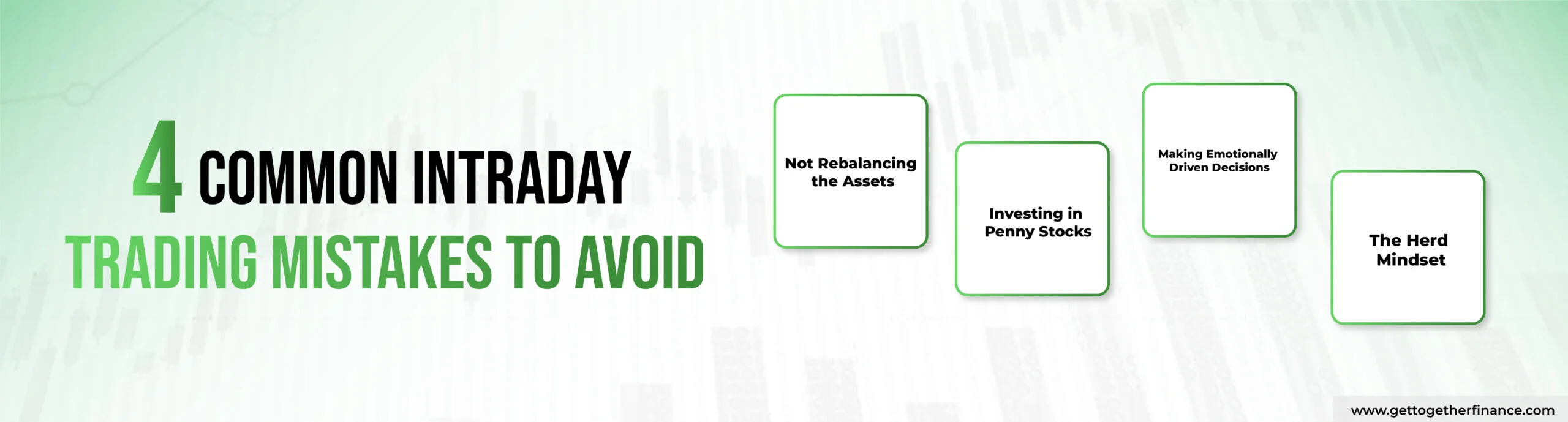
Here are four top mistakes you must avoid for more profitable and risk-free intraday trading sessions:
1. Not Rebalancing the Assets
Rebalancing involves periodically buying/selling assets in a corpus to maintain a desired level of risk. Day traders often forget to rebalance their assets, resulting in them getting overweight at market highs and underweight during market lows. This eventually leads to poor returns on investment (ROI).
2. Investing in Penny Stocks
While penny scripts offer significantly high returns, they come with high volatility. As a beginner, you should avoid penny stocks, given the high risk of capital loss.
3. Making Emotionally Driven Decisions
Making intraday trading decisions based on your instincts may hit the mark sometimes. However, gut feelings are mixed with personal options and sentiments, including panic, fear, and greed. So, succumbing to these emotions can influence you to make impulsive decisions, potentially leading to huge losses.
4. The Herd Mindset
Most new intraday traders commit the mistake of blindly following the actions and decisions of other investors – otherwise called herd behavior. With this mentality, you can end up paying more for equities or initiate short positions for scrips whose prices have already declined and can rise in the near future.
Who Should Do Intraday Trading and Who Should Avoid It

Intraday trading is not for everyone. While it allows generating quick profits, it also demands strong market understanding, emotional control, and discipline. Before you get started, ask simple questions– does this really suit who you are, what you want financially, and how much risk you’re comfortable with?”
Who Should Do Intraday Trading?
Regular Market Followers
Intraday trading requires constant attention as you have to close all your trades before the market shuts. If you can actively watch indices like NIFTY 50 or SENSEX throughout the day, then you can think about it.
Traders Who Have a Clear Plan and Budget
If you know how to manage your risk-reward ratio, read charts, size your positions right, and only trade with extra money, then intraday is the best option.
Traders with High Risk Tolerance
Intraday trading involves leverage and rapid price swings. Those who can handle short-term losses without fear are suited for this.
Disciplined and Calm Traders
Successful intraday traders strictly follow risk management rules and stop-loss levels. In intraday trading, emotional discipline is considered the most important strategy.
Individuals Seeking Short-Term Opportunities
If your main goal is to gain short-term income instead of long-term wealth creation, then intraday trading is best for you.
Who Should Avoid Intraday Trading?
People Who Cannot Handle Stress
The nature of intraday trading makes it stressful. Frequent price swings can trigger anxiety and fear, which can lead to impulsive decisions.
Those who use Borrowed or Essential Funds
Intraday trading is never done with emergency savings, essential funds, or borrowed money. It is not for those who do so.
Beginners Without Market Knowledge
Entering intraday trading without understanding volatility, risk management, or price action can lead to significant losses.
Long-Term Investors
Not everyone is made for intraday trading. If your goal is to build wealth slowly and earn dividend then you should avoid intraday trading.
Individual Without Time to Track the Market
Those who don’t have time to monitor charts during market hours may find it difficult to manage intraday positions effectively.
Key Takeaway: Discipline always wins over impulse.
Is Intraday Trading Profitable for Beginners?

Intraday trading can be profitable for beginners, but only under some conditions. Without emotional control, risk management, and proper knowledge, intraday trading can go from exciting to expensive very quickly. Let’s break it down realistically when iut can be profitable for beginners:
1. If They Start Small
Starting with a smaller amount keeps the stress low and keeps your emotions in check, which can help avoid big financial mistakes.
2. If They Develop Emotional Control
Having emotional control over oneself is so crucial. Intraday trading is really very fast; prices in indices like NIFTY 50 and SENSEX change constantly.
3. If They Focus on Learning First
Beginners who understand fundamental concepts such as position sizing, support and resistance, and risk-reward ratio.
4. If They Follow Strict Risk Management
Always use a stop-loss and never risk more than 1–2% of your capital on a single trade. This is the best way for beginners to protect themselves from losses.
Why It Is Difficult for Most Beginners?
According to studies and data from brokers, the majority of retail traders face difficulty in their first year. The main cause includes:
- Lack of strategy
- Trading based on tips
- Overtrading
- Trading out of frustration after a bad loss
- Ignoring stop-loss
Several beginners see the success of someone like Rakesh Jhunjhunwala and start intraday trading by expecting quick returns. However, those investors built wealth through long-term investing.
Trade Wisely, Trade Profitably

Intraday trading is challenging. Studies reveal 7 out of 10 day traders quit after the first year. Moreover, 95% of traders give it up by the third year.
The key to flourishing as an intraday trader lies in your own temperament. That means emotional management, the ability to watch stock markets like a hawk, make calculated moves, and then take tough buy and sell decisions at the right time. So, test-drive the tips and strategies discussed above and learn without staking all your savings.
Conclusion
Intraday trading give opportunity to generate quick income but also has high risk. The success of a trader depends more on emotional control, discipline, and risk management than on forecasting. If you really want to trade- start small, keep your capital safe, and stick to your plan. Markets like NIFTY 50 and SENSEX are unpredictable, but by managing risk, you can grow your account steadily.
FAQs
What is intraday trading?
Intraday trading is a financial strategy where traders buy and sell shares of a stock (s) within the same trading day. Also called day trading, traders aim to book profits from short-term price movements of stocks, capitalizing on price fluctuations that occur within minutes or hours.
How to do intraday trading?
For a successful trading day, always select stocks with high trading volumes for better liquidity and price movement opportunities. Meanwhile, perform in-depth technical and/or fundamental analysis to identify potential trades. Determine entry and exit points and stop-losses to manage risk. Closely monitor the chosen stocks, look for price triggers throughout the trading day, and execute your trades accordingly.
How to make money in intraday trading?
Follow these steps to make money in intraday trading:
1.Determine your risk appetite and risk-reward ratio.
2.Pick liquid stocks with high trading volumes. Avoid high-volatile scrips.
3.Stay updated on economic data, market news, and company announcements.
4.Use technical analysis to identify patterns, trends, and signals for more accurate trading decisions.
5.Set stop-losses and position sizing to avoid significant losses.
6.Keep a check on your emotions.
Is intraday trading profitable?
While intraday trading can be profitable, it is equally possible to incur losses. You must create a well-designed strategy, trade liquid stocks, monitor market sentiments, practice sound risk management, and stick to the plan. Only then will your chances of earning profits while minimizing potential losses increase.
Can NRI do intraday trading in India?
No, NRIs cannot execute intraday trades in India. Instead, they can only invest in future & options (F&O) and equity delivery. To trade in F&O, they must appoint a custodian and have a Custodian Participant (CP) code.
How to learn intraday trading?
You will find numerous online courses to learn intraday trading, but Get Together Finance stands out as the top pick. Our platform offers ISO-accredited certification, providing credibility to your skills. Gain the advantage of advance price action guidance for smarter trading decisions. Access lifetime mentorship support for tailored guidance, and become part of the vibrant GTF Community for knowledge sharing.
How to start intraday trading?
To start intraday trading, create a trading/demat account. Have an automated trading system (ATS) displaying charting platforms for real-time market situations and live data feeds. This ATS executes buy/sell orders based on rules defined by the trader.
Is intraday trading safe?
Intraday trading carries inherent risks due to the short-term nature of the trades and rapid market fluctuations. Hence, traders must prioritize in-depth research, a well-thought-out trading plan, proper risk management, and discipline. Moreover, they should invest what they can afford to lose.
How intraday trading works?
In intraday trading, traders look for stocks that can either move up or down. If a stock’s price will likely increase, traders buy low and sell high. Otherwise, they short-sell, meaning sell high and buy low. Intraday trades use technical analysis methods, track price movements, and watch relevant news and updates to mark potential entry and exit points.
Which time frame is best for intraday trading?
Common time frames intraday traders use include 5-minute, 15-minute, and 30-minute charts. Shorter time frames, like 1 or 5 minutes, are ideal for scalping and quick trades, while longer time frames, like 15 or 30 minutes, offer a broader view and may be better for swing trading within the same day.
Traders should choose a time frame that suits their trading style, risk tolerance, and desired level of activity.
Can government employees do intraday trading?
India’s Central Civil Service (Conduct) Rules, 1964 prohibits government employees (central or state) from engaging in speculative activities, including intraday and F&O. Government employees can rather invest in financial instruments if they wish to hold them for at least 6 months. These include mutual funds, national pension schemes (NPS), RBI bonds, and ETFs.
How to trade in nifty intraday?
Trading in Nifty intraday follows the same procedure as in other stock market indices. The only difference is that you have to trade stocks only under Nifty.
What is an intraday trading example?
Let’s say you purchase 100 shares of a stock at ₹100 apiece at 9:40 AM (amounting to ₹10,000) and sell them for ₹105 apiece at 12:40 PM. Here, you will make a profit of ₹5 on each share or 5% intraday profit.
What is margin in intraday trading?
Intraday trading margin allows traders to borrow their broker or brokerage firm’s resources to buy a larger stock quantity than they can afford in exchange for the shares. You must have a margin account instead of a regular brokerage account to execute trades on margins
Which app is best for intraday trading?
When it comes to learning intraday trading, the best app is one that offers comprehensive education and support. At Get Together Finance, we provide just that. Our program offers lifetime access to Free PDF Notes, a valuable GTF trader checklist, and advanced trading strategies in the zone. Plus, you’ll become part of our thriving 12,000+ member GTF community and receive an ISO-accredited certification upon completion.
How to do Bank Nifty intraday options trading?
Trading option contracts in Bank Nifty intraday follows the same process as in other stock market indices. Here, you have to buy/sell options of stocks only under the Bank Nifty index, including HDFC Bank, ICICI Bank, and Axis Bank.
How to do intraday trading in India?
The procedure for intraday trading in India is the same as in the global market. Pick liquid stocks, create a trading plan with entry and exit points, and implement strict risk management techniques like stop-loss orders. Use technical analysis, charts, and indicators to identify potential trades. Furthermore, continuously monitor the market and adhere to your strategy.
How to earn in intraday trading?
Intraday stocks always move according to the market sentiment. So, to earn profits in intraday trading, buy/sell stocks based on how the stock market performs. For instance, if the market is bullish, buy and sell a couple of times to book small profits instead of waiting for that significant move. Similarly, during bearish sentiments, short-sell and buy at lower levels to earn some small profits with 2-3 trades.
Keep up-to-date with market-related news and events and set stop losses and entry and exit points to reduce losses.
How to select stocks for intraday trading?
For optimal gains in intraday trading, choose stocks that:
1.Have high liquidity as they have high trading volumes.
2.Have medium-to-high volatility.
3.Show price movement corresponding to their sector.
How much can I earn in intraday trading?
Earnings in intraday trading vary widely and rely on multiple factors, including trading capital, strategy, risk management, and market conditions. If you are skilled enough and have strategies in place, you can mint in at least five or six-figure ranges. However, most intraday traders lose money in the markets. So, be extra-cautious with a well-defined risk-reward ratio while trading stocks.
Which candle is best for intraday trading?
Popular candlestick chart patterns for intraday trading include three white soldiers, morning star, hanging man, and shooting star. For instance, the effectiveness of these candlestick patterns varies, so combine them with other technical indicators and risk management strategies for successful intraday trading.