
Slippage in Trading: Meaning, Causes and How to Reduce It
- Updated on :
- 1 Views
- by Juhi Sharma

 Instagram
 Linkedin
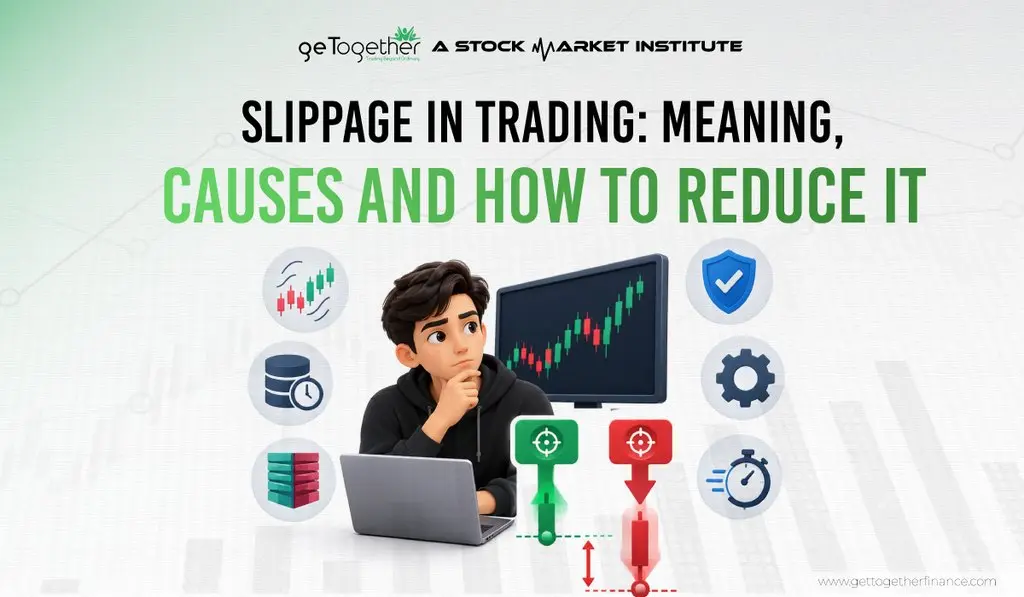
Imagine you are buying vegetables at the market. You see tomatoes selling at ₹40 per kilo, but by the time you walk to the shop and ask for two kilos, the seller has raised the rate to ₹45 because a crowd has just arrived. You still buy them, yet you end up paying more than the price you first saw. A very similar thing happens in the share market every single day, and it is called slippage in trading.
So, what is slippage, and why should every trader care about it? Most beginners notice slippage in stock market trading only when they check their trade and find that the price is slightly different from the one on their screen. At first, a difference of one or two rupees looks too small to worry about, but when you trade often or buy in large quantities, these small differences add up and quietly reduce your profit.
In this blog, we will go through slippage step by step, starting from the meaning and moving on to calculation, causes, real examples from NSE and BSE, and simple ways to keep it under control.
What Is Slippage in Trading?

In simple words, slippage is the difference between the price at which you expect your trade to happen and the price at which it actually happens. In other words, you click buy or sell at one price, but the market gives you a slightly different price by the time your order gets matched. Here are a few questions that come up when we talk about slippage.
- How Does Slippage Happen?
Slippage happens because the market keeps moving while your order travels from your trading app to the exchange. During this short time, the price may change, or the shares available at your price may get sold to someone else, so your order moves on to the next available price. For example, if you want to buy a stock at ₹250 but only a few shares are available at that rate, the rest of your order gets filled at ₹251 or ₹252.
- What Is Positive Slippage?
Positive slippage means you get a better price than the one you expected. For instance, if you place a buy order when the stock shows ₹500 and it gets filled at ₹498, you save ₹2 on every share. Although this feels like a pleasant surprise, you cannot depend on it, because it happens less often than negative slippage.
- What Is Negative Slippage?
Negative slippage means you get a worse price than expected, and this is the type that most traders worry about. If you place a sell order when the stock shows ₹320 and it gets filled at ₹317, you receive ₹3 less on every share. Since this directly reduces your profit or increases your loss, most of this blog focuses on understanding and reducing negative slippage.
- Can Slippage Be Zero?
Yes, slippage can be zero when your order gets filled at exactly the price you expected. This usually happens when you trade a highly liquid stock, such as a Nifty 50 company, or when you use a limit order and the market comes to your price. However, zero slippage is never guaranteed, because prices keep changing every second.
How Does Slippage Work in Stock Trading?
To understand how slippage in stock market trading works, it helps to look at what happens between the moment you press the buy or sell button and the moment your order is actually completed.
Expected Price vs Executed Price
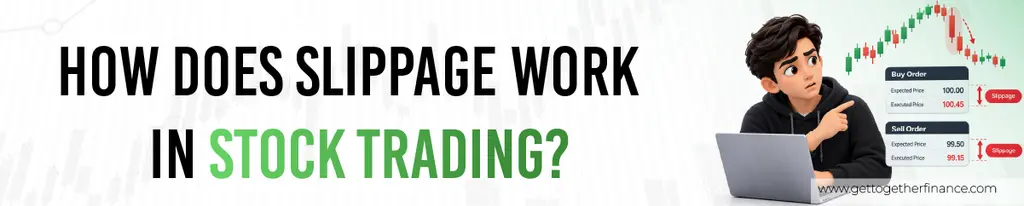
The expected price is the price you see on your screen when you place the order, while the executed price is the price at which the exchange actually matches your trade. Ideally, both should be the same, but in a fast market or in a stock with very few buyers and sellers, they can be different. The gap between these two prices is exactly what we call slippage.
Slippage When Buying a Stock
When you buy a stock, slippage means you pay more than the price you expected. For example, if you place a market order to buy 200 shares of a company showing ₹250 and the order gets filled at ₹252, you have paid ₹2 extra on every share. This adds up to ₹400 in total, and the extra cost never appears as a separate charge on your contract note, which is why many traders miss it.
Slippage When Selling a Stock
When you sell a stock, slippage works in the opposite direction, which means you receive less than the price you expected. If you place a market order to sell 150 shares showing ₹320 and the order gets filled at ₹317, you lose ₹3 on every share, which comes to ₹450 in total. As a result, your profit shrinks even if the price at which you originally bought was perfectly fine.
How to Calculate Slippage?

The good news is that calculating slippage is very simple, and you do not need any special tool or advanced maths to do it.
Slippage Calculation Formula
For a buy order, slippage equals the executed price minus the expected price, whereas for a sell order, it equals the expected price minus the executed price. If the answer is positive, you have lost money to slippage, and if it is negative, the market has given you a small bonus. To see it as a percentage, you can divide the slippage by the expected price and multiply the result by 100.
- Buy order: Slippage = Executed price − Expected price
- Sell order: Slippage = Expected price − Executed price
- Slippage %: (Slippage ÷ Expected price) × 100
Slippage Calculation Example
Let us use the buy example from earlier, where you expected to pay ₹250 per share, but the order was filled at ₹252. Here, the slippage is ₹252 minus ₹250, which is ₹2 per share, and for 200 shares, the total slippage is ₹400. In percentage terms, ₹2 divided by ₹250 and multiplied by 100 gives 0.8%. Similarly, in the sell example where you expected ₹320 but received ₹317, the slippage is ₹3 per share, ₹450 for 150 shares, and about 0.94% in percentage terms.
How Slippage Affects Trading Profit and Loss?

Slippage affects both ends of a trade, because you can slip once while entering and then again while exiting.
For example, suppose you plan to buy 200 shares at ₹250 and sell them at ₹255, which should give you a profit of ₹1,000.
If slippage makes you buy at ₹252 and sell at ₹254, your actual profit becomes only ₹400, which means slippage has quietly taken away 60% of your planned profit. This is why slippage matters so much for traders who aim for small gains on each trade.
What Causes Slippage in Trading?

Slippage rarely has just one reason, and in most cases, a few causes work together at the same time. Let us look at the most common ones one by one.
High Market Volatility
Volatility means how quickly and how strongly prices move up and down. When the market is volatile, the price you saw a moment ago may already be outdated by the time your order reaches the exchange, and therefore your trade gets filled at a different price. For this reason, days with big global news, important policy announcements, or a sudden fall in the Nifty usually bring higher slippage.
Low Liquidity
Liquidity simply means how easily you can buy or sell a stock without changing its price. A liquid stock has many buyers and sellers waiting at every price, so your order finds a match quickly, but an illiquid stock has only a few, so your order has to move on to the next available price. NSE even measures this with a number called impact cost, and a stock needs an average impact cost of 0.50% or less for at least 90% of observations over six months to qualify for the Nifty 50. In simple words, the Nifty 50 contains stocks that are easy to trade.
Large Order Size
The bigger your order, the more likely it is to slip, because one price level may not have enough shares to fill it completely. For instance, if you place a market order to buy 1,000 shares and only 300 are available at ₹80.00, the next 400 may come at ₹80.20 and the last 300 at ₹80.50. Your average price then becomes ₹80.23, so you end up paying ₹230 more than the ₹80.00 you expected.
Sudden News and Market Events
Company results, policy announcements and global events can change the price of a stock within seconds, and sometimes the market even opens far away from the previous day’s close.
For example, suppose you buy 100 shares at ₹500 and keep a stop-loss at ₹480, which means you are ready to lose ₹2,000. If the company announces weak results in the evening and the stock opens the next morning at ₹455, your stop-loss gets triggered, but nobody traded at ₹480, so you exit near ₹455 and lose ₹4,500 instead. The extra ₹2,500 is slippage, and your stop-loss did not really fail, because the price simply never traded at ₹480.
Trading During Market Open and Close
The first few minutes after the market opens at 9:15 AM and the last few minutes before it closes at 3:30 PM are usually very active. Many traders place their orders at the same time, so prices jump quickly, and the gap between buying and selling prices can become wider than usual. As a result, orders placed during these periods are more likely to get filled away from the expected price.
Difference Between Available Bid and Ask Prices
Every stock has a bid price, which is the highest price a buyer is ready to pay, and an ask price, which is the lowest price a seller is ready to accept. When you place a market order to buy, you pay the ask price, and when you place a market order to sell, you receive the bid price. Therefore, if the gap between the two is wide, you lose more right from the start, and the chance of slippage also becomes higher.
When Is Slippage Most Likely to Occur?

Now that we know the causes, it becomes much easier to spot the situations where slippage in trading is most likely to show up.
During the Opening Minutes of the Market
NSE runs a pre-open session from 9:00 to 9:15 AM to set the opening price, but even after the market starts, the first few minutes remain jumpy because everyone is reacting to overnight news. Therefore, many traders prefer to wait for 10 to 15 minutes before placing their orders so that prices have some time to settle down.
During Major News or Company Announcements
Whenever a company declares its quarterly results or a big policy decision is announced, many people rush to buy or sell at the same time. Consequently, buyers and sellers disappear from the price levels very quickly, and market orders get filled much further away than usual.
During Sharp Market Movements
Sharp moves in the overall market can create slippage even in strong stocks. For example, on 4 June 2024, when the Lok Sabha election results came out, the Nifty 50 closed nearly 6% lower, a fall of more than 1,379 points in a single day, according to HDFC Sky. On such a day, prices change so quickly that the number on your screen is often old before your order reaches the exchange.
While Trading Illiquid Stocks
Illiquid stocks have very few buyers and sellers, so the gap between the bid and ask prices is usually wide. For example, a small company may show a bid of ₹41.00 and an ask of ₹42.50, which is a gap of ₹1.50 or about 3.7%, while a large bank stock may show ₹1,500.00 and ₹1,500.50, which is a gap of only about 0.03%. Naturally, a market order in the first stock is far more likely to slip.
When Placing Large Market Orders
Large market orders are risky because they have to be filled by many sellers at different prices, and this pushes your average price away from the expected price. Therefore, if your order is bigger than what is available at the first few price levels, it is safer to split it into smaller parts or to use a limit order.
Market Order vs Limit Order: Which Has More Slippage Risk?

The type of order you choose is the biggest factor that you can control, so let us compare the two most common order types and see how each one handles slippage.
Slippage Risk With Market Orders
A market order tells the exchange to buy or sell immediately at the best available price, which means your order will almost always get filled, but you do not control the price. This is why market orders carry the highest slippage risk, especially in mid-cap stocks, small-cap stocks and options. To protect traders from extreme fills, BSE converts a market order into a limit order with a 3% protection band from the last traded price, and some illiquid NSE stocks follow a similar rule, according to Zerodha.
How Limit Orders Can Control Execution Price?

A limit order tells the exchange to buy or sell only at your chosen price or better, so you never get a worse price than the one you set. For example, if you place a limit order to buy at ₹100, it can get filled at ₹100 or lower, but never at ₹101. As a result, limit orders remove negative slippage, which makes them very useful in stocks that do not trade much.
When a Limit Order May Not Get Executed
The only drawback of a limit order is that it gets filled only when the market reaches your price.
For instance, if you place a limit order to buy at ₹98 and the stock never falls below ₹100 but moves up to ₹110, your order stays unfilled and you miss the whole move.
Sometimes the order may also get filled only partly, which means only some of your shares get bought. So, in the market order vs limit order choice, a market order gives you the certainty of getting the trade done, whereas a limit order gives you the certainty of the price.
How to Reduce Slippage in Trading?

Although you cannot remove slippage completely, a few simple habits can reduce it a lot, and the steps below show you how to reduce slippage without making your trading complicated.
Step 1: Trade Stocks With Higher Liquidity
Stocks with high trading volume, such as the Nifty 50 companies, have many buyers and sellers at every price, so orders get filled very close to the expected price. In the same way, Nifty and Bank Nifty options near the current market price usually slip less than far out-of-the-money options. Hence, choosing liquid stocks and contracts is the easiest way to cut slippage.
Step 2: Avoid Trading During Extreme Volatility
When the market is moving wildly, your order is more likely to get filled far from the price you saw. India VIX, often called the fear gauge, rises in such times and usually points to wider spreads and thinner order books. Therefore, it is wise to reduce your quantity, or even stay out for a few minutes, around results, policy announcements and budget days.
Step 3: Use Limit Orders When Appropriate
As we saw earlier, a limit order protects you from paying more than you planned, so it works best in mid-cap stocks, small-cap stocks and options. On the other hand, if you must exit quickly from a liquid stock, a market order can still be sensible, because getting out matters more than saving a rupee. In the market order vs limit order decision, the right choice depends on whether speed or price matters more at that moment.
Step 4: Check the Bid-Ask Spread Before Trading
Before placing an order, take a quick look at the gap between the bid and ask prices. If the gap is small, the stock is easy to trade, but if it is wide, a market order will cost you more from the very first second, so a limit order is usually the better choice.
Step 5: Avoid Placing Large Orders at Once
Instead of buying 1,000 shares in one go, you can split the order into smaller parts, such as five orders of 200 shares each placed a few minutes apart. This way, you do not use up many price levels at once, and your average price stays closer to what you expected.
Step 6: Check Market Depth Before Entering a Trade
Market depth shows the best five buy and sell prices, along with the quantity waiting at each one, so it works like a warning sign for slippage. Here is a simple example to see how it works.
Say the sell side shows:
- 200 shares at ₹100.00
- 300 shares at ₹100.05
- 500 shares at ₹100.10
If you buy 600 shares at market, your order fills like this:
- The first 200 shares are bought at ₹100.00.
- The next 300 shares are bought at ₹100.05.
- The last 100 shares are bought at ₹100.10.
What it costs you?
- The total cost is ₹60,025, so your average price is about ₹100.04.
- You expected ₹100.00, so you pay ₹25 extra because of slippage.
What to remember?
The amount is small here, but it grows quickly if your quantity is much bigger than the first two or three levels. So, before placing a large order, always compare your quantity with what is available at the best prices.
Slippage vs Bid-Ask Spread: What’s the Difference?

Many beginners think that slippage and the bid-ask spread are the same thing, but they are two different costs that usually work together.
What Is Bid-Ask Spread?
The bid-ask spread is simply the gap between the highest price a buyer will pay and the lowest price a seller will accept at a given moment. For example, if the bid is ₹99.90 and the ask is ₹100.00, the spread is ₹0.10, and you can see it clearly even before you place your trade.
How Spread and Slippage Affect Trading Costs?
The spread is a cost that you can see in advance, whereas slippage only becomes visible after your order is filled.
For example, with a bid of ₹99.90 and an ask of ₹100.00, a market buy order costs you ₹100.00 straight away, which is the spread cost. If your order is big and the last few shares get filled at ₹100.10, that extra ₹0.10 is slippage on top of the spread, and together they decide your real trading cost.
Impact cost is the exchange’s way of measuring this cost for a large order, so a stock with a wide spread and a high impact cost will usually show more slippage.
Slippage Example in Intraday Trading

Intraday traders feel slippage in stock market trading the most, because they buy and sell within the same day and their profit on each trade is usually small.
Buy Order Slippage Example
Suppose an intraday trader wants to buy 300 shares of a stock showing ₹180 and places a market order at 9:16 AM. Because the market has just opened and prices are moving quickly, the order gets filled at an average of ₹180.40, which means the trader pays ₹0.40 more on every share, or ₹120 in total.
Sell Order Slippage Example
Later in the day, the same trader decides to sell all 300 shares when the price shows ₹186, and again uses a market order. This time, the order gets filled at ₹185.60, so the trader receives ₹0.40 less on each share, which is another ₹120. As a result, the trader loses ₹240 to slippage in just one trade, and the planned profit of ₹1,800 falls to ₹1,560.
Slippage During a Fast-Moving Market
Now imagine that a positive news item arrives and a stock showing ₹400 starts rising very fast. You place a market order to buy 500 shares, but by the time your order is matched, the price has already moved to ₹404 and ₹406, and your average fill price turns out to be ₹405. That is ₹5 extra on every share, so you pay ₹2,500 more, which is a slippage of 1.25%. This is a good reminder that chasing a fast-moving price with a market order can be very expensive.
Common Slippage Mistakes Traders Should Avoid

Most slippage losses come from a few repeated habits rather than bad luck, and fortunately, these habits are easy to fix once you know them.
#1. Using Market Orders in Illiquid Stocks
Many beginners use market orders in small stocks to get a quick entry, but with so few sellers available, the order may jump through several price levels. Instead, a limit order protects you from paying a much higher price than you planned.
#2. Ignoring Market Depth
Some traders place big orders without looking at how many shares are actually available at the best prices. Consequently, they are surprised when the average price turns out to be much worse than the one they saw, and a quick look at market depth before every large order can prevent this.
#3. Trading During Sudden News Events
Jumping into a stock right after a news headline feels exciting, but prices are at their most unpredictable at that moment. In addition, many broker guides note that NSE no longer offers stop-loss market orders on options, so exits can become tricky when the market is moving fast, and it is usually better to wait for the price to settle or to reduce your quantity.
#4. Assuming the Displayed Price Is Guaranteed
The price on your screen is only the last traded price, and it does not promise that your order will get filled there. Similarly, a stop-loss at ₹480 does not guarantee an exit at ₹480, because if the stock gaps below that level, your order is filled at the next available price. Therefore, it is always better to treat the displayed price as a guide and not as a promise.
Final Thoughts

So, what is slippage in the end? It is simply the gap between the price you expected and the price you got, and it is a natural result of fast markets and limited liquidity. Although slippage in trading cannot be removed completely, you can manage it well by choosing liquid stocks, checking the bid-ask spread and market depth, and using the right order type in the market order vs limit order decision.
If you remember only one thing about how to reduce slippage, let it be this: do not ask for instant execution unless you really need it. Over time, these small and simple habits can save a good amount of money, and at GTF, we believe that good trading is built on exactly such careful habits.
Slippage FAQs

Is slippage normal in trading?
Yes, slippage in stock market trading is completely normal because prices keep moving and the number of buyers and sellers keeps changing. In large and liquid stocks it is usually very small, whereas in small-cap stocks and far out-of-the-money options it can be much bigger.
Can slippage be avoided completely?
No, it cannot be avoided completely, since nobody can control how the market moves between your click and your fill. However, if you want to know how to reduce slippage, you can start by trading liquid stocks, using limit orders, checking market depth and staying careful during big news.
Is positive slippage possible?
Yes, positive slippage is possible, and it happens when your order gets filled at a better price than the one you expected, such as buying at ₹498 when you expected ₹500. Still, it happens less often than negative slippage, so it is better to treat it as a bonus and not as a part of your plan.
Does slippage happen with limit orders?
A limit order will not get filled at a price worse than your limit, so you will not face negative slippage in the usual sense. However, the order may get filled only partly, or may not get filled at all, if the market moves away from your price, and a stop-loss limit order may leave you holding the position if the price falls past your limit.
Does high liquidity reduce slippage?
Yes, high liquidity reduces slippage because there are many buyers and sellers at every price level, so your order gets matched quickly at or near the price you expected. That is why Nifty 50 stocks usually have much lower slippage than small-cap stocks.