
Bearer Share: Definition, Example, Risks, and Benefits
- Updated on :
- 4957 Views
- by Suhani

 Instagram


Bearer shares are a relic of veteran market investors but hold a good mystery in current market times. These are unique security instruments where the owner of the share is not registered anywhere with the issuer. The only proof one holds is the physical certificate of the share that is redeemable for the benefits.
These are beneficial for both the company and the owner of the shares. Both the company and the shareowner do not want them to be registered and enjoy the benefits of the share in a discreet way. Though as intriguing as it sounds, it has its own share of drawbacks. In this blog, we’ll look into everything related to bearer shares.
What are Bearer Shares?

Bearer shares are a type of stock or equity ownership where the physical share certificate is given to the owner. It is not registered in any name; it is just proof of having a certificate made to the legitimate owner. Bearer shares are not issued under the supervision of a higher authority. They are simply issued in physical certificate form to validate the owner and give them its benefits when they show it physically. No record is mentioned in the books of the company on the issuance of bearer shares.
The company is entitled to give dividends to shareholders when the physical coupon or the certificate is presented to them by the owner.
Since there is no security authority involved, they lack transparency. The majority of people buy them to convert their cash into liquid assets. It helps them get fixed income regularly in the name of dividends without highlighting themselves in legal books.
After understanding bearer shares, let’s look at its benifits.
Benefits of Bearer Shares

In India, bearer shares are not as popular as in Western Europe and America. Wealthy people in these countries have utilized bearer shares to protect their assets and convert cash into liquid assets. However, this has impacted government policies severely. Investors were accused of undermining government policies through anonymous illegal activities.
Anonymity: The foremost and only good benefit of a bearer share is having a private yet strong source of income. This is the reason many governments and corporations repel the idea of bearer share and have considered it illegal. The highest level of anonymity for the owner is maintained since there is no track record of it.
REMEMBER: The shares are issued through the banks, but in no case are banks obligated to or can be forced to disclose the identity of the shareowner to any person or legal entity. This way, the bearer share comes as a rescue for people who don’t want to get in legal trouble for their assets. They try to keep them discreet with the physical share certificates.
Easy to Transfer: Another great advantage that bearer shares hold is the ease of transfer. They can simply be transferred by handing over the certificate to the other person. Keeping the anonymity top-notch yet making sure the money is transferred. This streamlined and easy process reduces the transaction cost and the involvement of administrative authorities.
Minimize Tax Liability: When your assets are hidden from the government, automatically you get a lease in the tax. Tax liabilities reduce with reduced assets.
Useful in International Transactions: Bearer shares are used in international transactions. They are easy to transfer for transactions with higher amounts. The complex transfer and registration process need is eliminated with bearer share. Followingly the, jurisdictions with capital controls and tax implications can be easily avoided.
While these advantages may appeal to certain investors and businesses, it is critical to recognize that bearer shares also involve considerable dangers, particularly in terms of transparency, compliance, and potential for criminal use. As a result, considerable deliberation and thorough diligence are required before selecting bearer share arrangements.
These features may seem attractive, but bearer shares also come with big risks that investors need to understand.
Risks of Bearer Shares
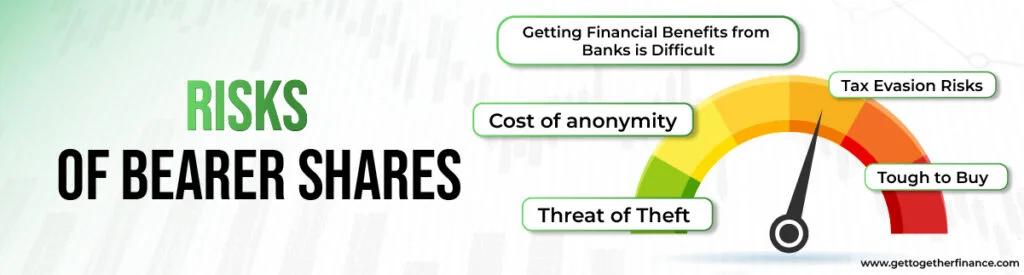
The risks linked to bearer shares have made them less common in today’s financial markets. Many countries and companies have introduced stricter rules to improve transparency and prevent misuse. Let’s look at some examples that show how bearer shares have been used and regulated over time.
Cost of anonymity: As easy as it sounds to buy shares anonymously, it is equally expensive. The owner needs to hire professionals to maintain their anonymity during the buying procedure without involving any legal trouble.
Tough to Buy: Considering the changing world and increased corruption, terrorism, money laundering cases, and other fraudulent activities, having anonymous shares is getting difficult. Many jurisdictions and governments strictly condemn the buying of bearer shares.
Threat of Theft: As much as ease of transfer serves as a benefit, it is equally threatening. Since shares are only available in physical form, they can be easily stolen. Nothing can be done if the physical certificate gets into the wrong hands. As soon as you lose the physical certificate of our coupon, you lose ownership.
Tax Evasion Risks: When you conceal your assets from the government, you become their target, accused of tax evasion and money laundering. Keeping all the procedures low-key is quite difficult.
Getting Financial Benefits from Banks is Difficult: Banks usually refrain from giving financial assistance to entities that offer bearer shares. The reason is that there is no legal proof of their owners, and the ownership is easily transferable, which raises questions for the bank.
Because of these risks, many countries and companies have changed their rules around bearer shares. The examples below show how bearer shares have been used in the past, and how these rules have evolved over time
Examples of Bearer Shares

The risks and rules around bearer shares have led to major changes in many countries and companies. By looking at real examples, you can understand how bearer shares were used and why many places later introduced stricter rules. Here are some notable examples.
- Luxembourg
Earlier in Luxembourg, the jurisdiction was favorable for bearer shares. The financial services industry was at ease with this jurisdiction, and many people were able to keep their money out of the government’s eyes with this. But, with increased fraudulent activities and rising inflation, the jurisdiction and tax regimes were forced to change. Though it attracted international funding, Luxembourg has now reformed policies to attract reliable international investments with increased transparency.
- Switzerland
Currently known as a good and strong economy, once had the jurisdiction to hide assets in the name of bearer shares. The country has secrecy in banking laws and owner-friendly tax policies. This attracted companies from around the globe to Switzerland. In no time, it became a go-to destination for offshore companies for managing their wealth. Swiss corporations offered anonymity and flexibility in wealth management in the name of bearer shares. However, in recent years, Switzerland has implemented measures to enhance financial transparency and combat money laundering, leading to restrictions on bearer shares.
- Volkswagen Ag
Earlier, Volkswagen, one of the world’s well-known automobile manufacturers, issued bearer shares. Bearer shares of Volkswagen were traded on stock exchanges too. It gave investors anonymity and simplicity of transfer. However, in 2008, Volkswagen converted all of its bearer shares to registered shares to comply with new German legislation aimed at boosting transparency and shareholder rights.
- Credit Suisse Group AG
It is a Swiss global investment bank and financial services firm and is another company that has earlier issued bearer shares. Credit Suisse’s bearer shares provided investors with confidentiality and autonomy in managing their investments. Credit Suisse, like many other Swiss banks, has phased out bearer shares as a result of legal changes and global efforts to combat financial crime.
Conclusion
In conclusion, bearer shares, which were formerly popular among investors seeking anonymity and flexibility, have become increasingly rare as a result of legal changes and global efforts to improve transparency and combat financial crime. While bearer shares have advantages such as anonymity, ease of transfer, and potential tax benefits, the hazards connected with them, such as lack of transparency, susceptibility to fraud and theft, and regulatory scrutiny, often exceed the benefits.
Recent instances from Luxembourg, Switzerland, and firms such as Volkswagen and Credit Suisse demonstrate the changing landscape of bearer shares. As investors and businesses manage the intricacies of modern finance, it is critical to carefully analyse the benefits and dangers before considering alternative investment options that prioritize transparency, compliance, and long-term sustainability.
FAQ