
Position Sizing in Trading: Formula, 1% Rule & Examples
- Updated on :
- 8 Views
- by Juhi Sharma

 Instagram
 Linkedin
Most traders spend hours picking the perfect entry point and almost no time deciding how much money to actually put into that trade. This is a mistake. You can pick a great entry and still lose a big chunk of your account simply because you traded too big a size. Position sizing in trading is the one habit that decides whether you stay in the game long enough for your strategy to actually work. In this guide, we will go through the formula, the popular 1% rule, and enough examples that you can start applying this today.
What Is Position Sizing in Trading?

Position sizing means deciding how many shares, lots, or contracts you should buy or sell in a single trade. It has nothing to do with how much profit you hope to make. It is entirely about how much money you are okay with losing if the trade does not work in your favour.
Here is a simple way to understand it. Two traders can look at the same chart and take the exact same trade but end up with very different results just because one of them sized the trade properly and the other did not. Position sizing in trading is what turns trading from a random guess into something you can actually plan and repeat, trade after trade.
Why Is Position Sizing Important?

No trading strategy wins every single time. Losses will happen, no matter how good your setup is. What separates traders who survive for years from traders who quit after a few bad months is not some secret indicator. It is simply how carefully they control the size of each trade.
Before we go further, it helps to know two terms that come up again and again in any conversation about risk. Account risk is the total amount of your capital you are willing to lose across your trading, usually written as a small percentage, such as 1 or 2 per cent. Trade risk is the actual rupee amount you stand to lose on one specific trade, based on the gap between your entry price and your stop loss. Once you know both of these numbers, working out the correct size becomes a simple calculation rather than a guess.
Position Size vs. Risk Per Trade
People often confuse these two terms, so let us clear it up properly. Position sizing in trading tells you how many units you are trading, for example, 200 shares. Risk per trade tells you how much money you stand to lose if your stop loss gets hit, for example, ₹1,500. The same position size can carry completely different risk depending on where you place your stop loss. This is exactly why smart traders decide their risk per trade first and then work backwards to find the correct position size, instead of picking a random number of shares and hoping for the best.
How Position Sizing Controls Trading Risk?
When you size your position based on a fixed percentage of your account, you are automatically putting a limit on how much damage any single trade can do. Even if you go through a rough patch and lose five or six trades in a row, good position sizing means your account takes a small hit, not a fatal one. Without this kind of control, one bad trade, or one moment where you get overconfident, can wipe out weeks or months of hard-earned profit. This is also why position sizing is treated as the foundation of risk management in trading, more important in many ways than the entry signal itself.
Why the Same Position Size Does Not Mean the Same Risk?

Picture two traders who both buy 500 shares of the same stock at ₹500.
Trader A places a stop loss at ₹490, so the risk per trade is ₹10 per share, which comes to ₹5,000 in total.
Trader B places the stop loss much lower at ₹470, so the risk becomes ₹30 per share, which comes to ₹15,000 in total. Same number of shares, but the second trader is risking three times more money.
This is exactly why “how many shares should I buy” is the wrong first question. The right first question is always “how much am I willing to lose.”
Position Sizing in Trading Formula

Now let us look at the actual math behind all this. It looks intimidating at first, but once you see it worked out with real numbers, it becomes very easy to remember.
The Basic Position Sizing Formula
At the core, the position size formula is this.
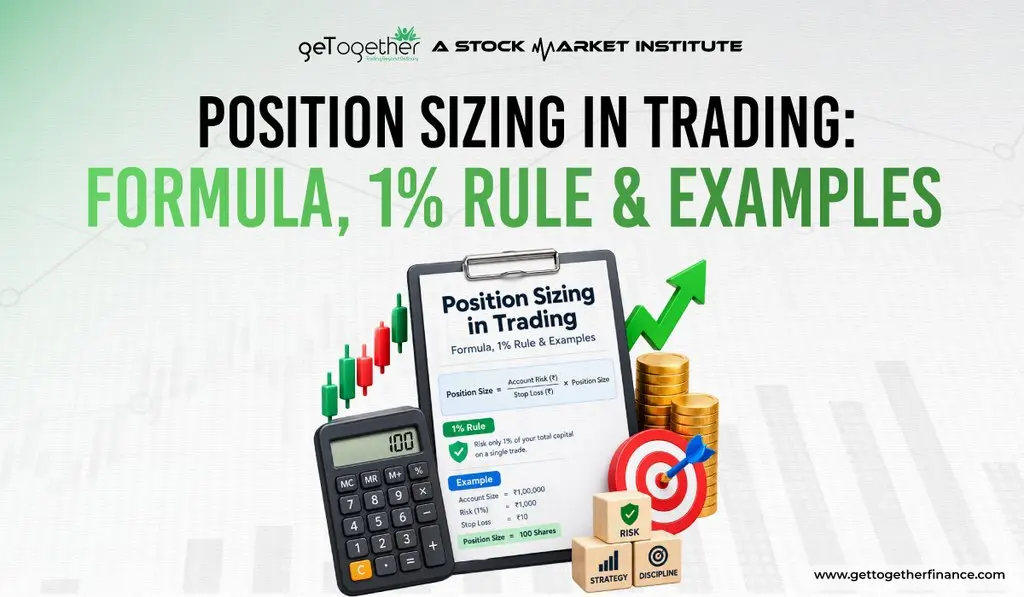
Position size equals the amount you are willing to risk divided by the risk per share.
That is really all there is to it. Every other version of the position size formula is just this same idea applied to a different market.
Position Size Formula Using Stop Loss Distance
Your stop loss distance is simply the gap between your entry price and your stop loss price. It tells you exactly how much money you will lose per share if the trade goes against you.
Risk per share = Entry Price – Stop Loss Price
Position size =Rupee Risk / Risk Per Share
Position Size Formula for Percentage Risk
Most experienced traders do not risk a fixed rupee amount every single time. Instead, they risk a fixed percentage of their account balance. This way, the position size naturally grows or shrinks along with the account, and this version of the position size formula is the one used most often in real trading.
Rupee risk = Account size * Risk Percentage
Position size = Rupee risk / difference between entry price and stop loss price
Position Sizing Example
Let us put some real numbers to this. Suppose you have a trading account of ₹10,000 and you are comfortable risking 1 per cent on a single trade. That works out to ₹100 of risk per trade.
You want to buy a stock at ₹50, and looking at the chart, you decide your stop loss should sit at ₹48. That means your risk per share is ₹2.
₹100 divided by ₹2 gives you 50 shares.
So in this trade, you would buy 50 shares. If your stop loss gets hit, you lose exactly ₹100, which is 1 per cent of your account. Nothing more, nothing less.
How the 1% Risk Rule Works?

What Is the 1% Rule in Trading?
The 1 per cent rule simply says that you should never risk more than 1 per cent of your entire trading account on one single trade. If your account has ₹50,000 in it, this means the most you should lose on any one trade is ₹500. Forbes Advisor also discusses the 1 per cent rule as a risk management guideline for limiting potential losses. It sounds almost too basic to matter, but this one habit can help traders keep their potential losses under control.
Is the 1% Rule a Universal Rule?
Not really. The 1 per cent rule is a well-respected guideline that most traders follow, but it is not a fixed law that applies exactly the same way to everyone. Some retail traders and fund managers prefer the slightly looser 2 per cent rule, risking up to 2 per cent of capital per trade instead of 1. There is also a lesser-known guideline called the 3-5-7 rule, where a trader limits any single trade to 3 per cent of capital, keeps total exposure across all open trades to 5 percent, and aims for winning trades that bring in at least 7 percent more profit than the losing trades cost. None of these numbers are magic. What truly matters is not the exact percentage you choose, but the discipline of sticking to that number on every single trade.
When Traders May Use More or Less Than 1% Risk
If you are just starting out or still testing a new strategy, it is safer to stick with 1 per cent or even less, since mistakes are more common in the early stages. Traders with a strong and proven track record sometimes go up to 1.5 or 2 per cent on trades where they feel very confident. On the other hand, during periods of high volatility, or when trying out a brand new strategy for the first time, dropping down to 0.5 percent is a smart way to protect your capital while you figure things out.
How to Calculate Position Size Step by Step?

Let us walk through the entire process from the very beginning, one step at a time.
Step 1: Determine Your Account Size
This is simply the total money sitting in your trading account right now. If you have ₹5,000 in your trading account, that number is your account size.
Step 2: Choose Your Risk Percentage
Decide how much of your account you are willing to risk on this particular trade. For most traders, this number usually falls somewhere between 0.5 percent and 2 percent, and it should be chosen with your target risk reward ratio in mind so the two numbers work together rather than against each other.
Step 3: Calculate Your Maximum Rupee Risk
Multiply your account size by the risk percentage you chose. A ₹5,000 account at 1 percent risk gives you ₹50 as your maximum rupee risk for this trade.
Step 4: Determine Your Stop Loss Distance
Look at the chart carefully and decide where your stop loss should be placed. Ideally, this should be based on a proper technical level such as support, resistance, or a moving average, and not just a random guess. Subtract your stop loss price from your entry price to get this distance.
Step 5: Calculate Your Position Size
Divide your rupee risk from Step 3 by the stop loss distance from Step 4 using the position size formula shown earlier, or simply plug these same numbers into a position sizing calculator if you prefer not to do it by hand. Whatever number you get is the amount of shares, lots, or contracts you should trade.
Position Sizing Examples

Let us apply this same position size formula across a few different markets so you can see how it works no matter what you trade.
Stock Trading Position Size Example
Account size is ₹15,000. Risk per trade at 1 percent comes to ₹150. Entry price is ₹80, and stop loss is ₹76, which is a ₹4 risk per share. Position size becomes ₹150 divided by ₹4, which is 37 shares, rounded down.
Forex Position Size Example
In forex trading, risk is usually measured in pips rather than rupees per share. Suppose your account size is ₹80,000 and your risk per trade at 1 per cent is ₹800. Your stop-loss distance is 25 pips, and each pip is worth roughly ₹8 per standard lot. A full lot would risk ₹200 for every pip, so dividing your total risk properly tells you to trade a much smaller portion of a lot to keep your risk right around ₹800.
Crypto Position Size Example
Account size is ₹1,60,000. Risk per trade at 1 percent comes to ₹1,600. You want to buy Bitcoin at ₹48,00,000, with a stop loss at ₹47,20,000, which is a ₹80,000 risk per coin. Position size becomes ₹1,600 divided by ₹80,000, which comes to 0.02 BTC.
Futures Position Size Example
Account size is ₹2,00,000. Risk per trade at 1 percent comes to ₹2,000. You are trading a futures contract where every point is worth ₹40, and your stop loss is 10 points away, meaning a ₹400 risk per contract. Position size becomes ₹2,000 divided by ₹400, which comes to 5 contracts.
Position Sizing in Trading With Stop Loss
(Why the Stop Matters)

Your stop loss is not just the point where you exit a losing trade. It is the anchor that your entire position size calculation depends on. If you move your stop closer to your entry, your position size can go up while your rupee risk stays exactly the same. If you move it further away, your position size has to come down to keep the risk equal. This is exactly why guessing your stop loss instead of basing it on the actual chart throws off every single number that comes after it. A careless stop loss almost always leads to a careless position size, no matter how neat your math looks on paper.
It is also worth remembering that a stop loss cannot always protect you perfectly. During sudden news events or overnight gaps, the price can jump straight past your stop loss level and get filled at a much worse price than planned. This is called gap risk, and it is one reason many traders reduce their position size before earnings announcements or major economic events, even if their normal position size formula suggests a bigger number.
Learn More: Intraday Trading vs. Positional (Delivery) Trading: What’s the Difference
How Position Sizing Changes With Account Size?

As your trading account grows or shrinks, your position size should naturally move along with it, especially if you are using percentage-based risk.
₹5,000 Account Example
At 1 percent risk, that comes to ₹50 per trade. With a stop loss distance of ₹2.5, you would end up buying 20 shares. Smaller accounts naturally lead to smaller, sometimes slightly awkward position sizes, which is why many beginners choose to trade lower priced stocks in the beginning.
₹50,000 Account Example
At 1 percent risk, that comes to ₹500 per trade. With the same ₹2.5 stop loss distance, you would be buying 200 shares, which is ten times bigger, simply because the account itself is ten times bigger.
₹5,00,000 Account Example
At 1 percent risk, that comes to ₹5,000 per trade. With that same ₹2.5 stop loss, you would be looking at 2,000 shares. Notice that the risk percentage never changed throughout any of these examples. Only the rupee amounts and the share counts grew as the account grew.
Position Sizing and Risk Reward Ratio

Position sizing in trading and risk-reward ratio always work together as a team. Risk reward ratio simply compares how much you stand to gain against how much you are risking on a trade. A risk reward ratio of 2 to 1 means you are aiming to make ₹200 for every ₹100 you are risking. But even a great risk reward ratio cannot save you if your position size is too large, because one single loss could still wipe out weeks of hard-earned gains. On the other hand, when correct position sizing is paired with a solid risk reward ratio, your winning trades can comfortably outweigh your losing trades, even if you are only right about half the time.
This is also connected to something traders call win rate. A trader who wins only 40 percent of trades can still be profitable if their risk reward ratio is strong and their position sizing is sensible. Meanwhile, a trader who wins 70 percent of trades can still lose money overall if their position size is too large on the losing 30 percent. Win rate alone never tells the full story. Position sizing decides how much damage the losses actually do.
5 Mistakes That Traders Should Avoid in Position Sizing

Let’s discuss the mistakes that should be avoided by traders while position sizing:
Risking the Same Number of Shares on Every Trade
Buying a fixed number of shares out of pure habit, no matter the price or volatility of the stock, completely defeats the purpose of position sizing. A stock priced at ₹50 and a stock priced at ₹5,000 carry very different amounts of risk even when you buy the same number of shares of each.
Ignoring Stop Loss Distance
Skipping the step of setting a proper stop loss, and instead just picking a position size that feels right, removes the entire foundation the position size formula is built on. Without a clearly defined stop loss, you do not actually know your real risk per trade. You are simply guessing and hoping things work out.
Increasing Position Size After a Loss
This is one of the quickest ways to damage an account beyond repair. Trying to win back a previous loss by doubling your position size turns a manageable setback into a much bigger problem, because at that point your emotions are driving the decision, not your plan.
Using Leverage Without Calculating Total Risk
Leverage has the power to magnify both your gains and your losses. Many traders make the mistake of sizing their position based on how much margin they have available, instead of their actual rupee risk. This is dangerous because leverage can quietly turn a small stop loss distance into a very large loss if the position size is not recalculated properly to account for it. When a leveraged position moves too far against you, your broker can issue what is known as a margin call, asking you to add more funds or close the position immediately. Ignoring position sizing while using leverage is one of the fastest routes to receiving one of these calls.
Ignoring Volatility
Treating a calm, steady stock and a wildly swinging one as equally risky, just because you used the same rupee amount on both, is a common blind spot. More volatile assets deserve a smaller position size to carry the same real level of risk.
Key Takeaways

- Position sizing in trading decides how many shares, lots, or contracts you buy, based on how much you are willing to lose, not on how much you hope to make.
- The position size formula is simple at heart. Take the amount you are willing to risk and divide it by your risk per share, which comes from your stop-loss distance.
- The 1% rule says you should not risk more than 1 per cent of your account on a single trade, though some traders use 2 per cent, and a few follow the 3-5-7 rule instead.
- Your stop loss distance controls your position size directly. A tighter stop allows a bigger position, and a wider stop needs a smaller one, for the same rupee risk.
- The same position size can carry very different risk depending on where the stop loss sits, so always check risk per trade before checking the number of shares.
- A strong risk reward ratio only helps if your position size stays sensible. Oversized trades can undo the benefit of good risk reward ratios and a high win rate.
- Common mistakes include using the same share count on every trade, skipping the stop loss step, increasing size after a loss, and using leverage without recalculating total risk.
- As your account grows or shrinks, your position size should move with it, so the rupee amount you risk stays proportional at every account size.
Getting comfortable with these basics, the 1% rule, stop loss distance, and the position size formula- is what separates traders who last for years from traders who lose their capital in a few bad months. Decide your risk first, and let that one decision guide every trade you take from here on.