
Swap Market: Understanding Its Role in Finance
- Updated on : February 17, 2026
- 1824 Views
- by Arun Singh Tanwar

 Facebook
 Instagram
 Youtube
 Linkedin
Have you ever been in a situation where you had two choices and chose the wrong one? Happens every time, right? But on a serious note, is there a way out if you feel stuck with the wrong choice? In the world of finance, Swap markets can help you.
In this blog, we discuss the basics of swaps, the different types of swaps, their functions, and more.
What is Swap Market?
Swap markets are over-the-counter financial markets where two parties agree to exchange their cash flows for identical assets or liabilities. These can be interest rates, commodities, currencies, equity, or credit risk. You can use swap markets to hedge your risks or for speculative purposes.
Let’s take a simple example to understand this.
Suppose A, B, and C are three friends. They go to a bank to invest in an FD:
- A invests ₹ 1 lakh in a fixed rate FD that pays 8% p.a. Interest
- B invests ₹ 2 lakhs in a floating rate FD that pays Base Rate + 1% as interest.
- C invests ₹ 1 lakh in a fixed rate FD that pays 8% p.a.
After a month, A and C believe that interest rates will increase in the future, while B believes that they can come down. Now, a swap market will help them exchange their interest rates, but only for an identical sum of money.
Both A & C agree to swap their interests with B for the Notional Principal of ₹ 1 lakh, each giving rise to two swap contracts. One between A & B and another between B & C. After 1 year, the Base Rate stays at 6%. Now, here’s how the Swap occurs.
| Particulars | A | B | C |
| Notional Principal | 1,00,000 | 2,00,000 | 1,00,000 |
| Interest Rate | 8% | 6+1 = 7% | 8% |
| Interest Received | ₹ 8,000 | ₹ 14,000 | ₹ 8,000 |
| Swapped Rates | 7% | 8% | 7% |
| Swapped Interest | ₹ 7,000 | ₹ 16,000 | ₹ 7,000 |
| (Short) or Excess | ₹ 1,000 | (₹ 2,000) | ₹ 1,000 |
| Net Effect of the Swap | Both A & C pay ₹ 1,000 each to B at the end of the year. |
Types of Swaps
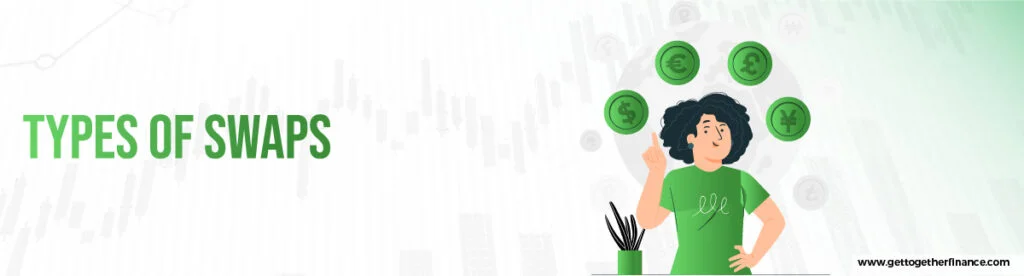
After understanding the basic concept, here are the types of swaps available in a swap market:
Interest Rate Swaps (IRS)
IRS is the most common type of swap. When two parties exchange their interest rates on a loan, it is called an Interest Rate Swap (IRS). While one party pays a fixed rate, the other pays a floating rate. Both think they are paying higher interest, and the better option is swapping.
They agree to the interest rate swap on a Notional Principal amount using the swap market. It is called notional, as the principal never changes hands. Only the interest payment is adjusted at fixed intervals, i.e., monthly, quarterly, half-yearly, or annually.
*In India, MCLR (Marginal Cost of Lending Rate) was used by RBI as the base rate for floating rate loans.
**However, the EBLR (External Benchmark Lending Rate) has been introduced since 2019, which is comparatively lower and is replacing the MCLR.
***EBLR = Repo Rate + Cost of Lending or Spread (which can differ for each bank).
Currency Swaps
When the principal and interest on a loan in one currency are exchanged with the principal and interest in another currency, it is called a currency swap. Companies use currency swaps to secure cheaper debts or hedge against the risk of exchange rate fluctuations.
Credit Default Swaps (CDS)
CDS is used as insurance against the default risk on a loan. In case the borrower defaults, the loan insurer charges a premium from the borrower in return for the guarantee to pay off the loan.
Commodity Swaps
Commodities can be bought at fixed or floating rates linked to an index. A risk-averse buyer can exchange the floating rate with a fixed rate through the swap market to avoid price volatility risk.
Equity Swaps
Equity swaps are derivative contracts that happen between:
- An investor who owns an equity portfolio but believes that the stock market will drop in the short term and
- A person wanting to get exposure to the stock market without having to invest real money
The investor swaps the market returns in exchange for a fixed interest payment on the notional principal, i.e., the invested amount. There are no swaps in the stock market. Even equity-related swaps are carried out over the counter.
Also Read: Debt-Equity Swap
Functions and Purposes of Swap Markets
Swaps are used for multiple purposes & uses including:
- Risk management: Every investment carries risk. Swap markets provide a safety net against credit, currency, and market risks.
- Speculation: Swaps can make speculative gains on interest rates, currency values, etc.
- Arbitrage: There are discrepancies in fixed and floating returns. Swap pricing is used to identify these opportunities and capitalize on them.
- Access new markets: Companies can access new markets and tap into international funding sources using swap markets.
Who are the Key Participants in the Swap Market?

The swap market involves several key participants who assist in the creation, supervision, and implementation of swap agreements. To understand how the swap market operates, it is essential to recognize the key participants and their respective roles.
- Corporations
Companies use swaps as a tool to mitigate financial risk, such as changes in interest rates and volatility in commodity prices.
- Institutional Investors
Hedge funds, mutual funds, and other institutional players use swaps to enhance portfolio diversification, access assets without owning them, and lower risks.
- Clearing Houses
In some regulated swap transactions, clearing houses act as intermediaries between participating parties.
- Government Agencies and Central Banks
Government bodies use swaps to reduce interest rate risk and control their financing costs. There are certain situations in which central banks use currency swaps to maintain sufficient liquidity and manage changes in the exchange rate.
- Financial Organizations and Banks
Investment and commercial banks play an essential role in the swap market. These institutions serve as intermediaries. Occasionally, they trade swaps on their own to generate income and control financial risk.
- Swap Dealers and Market Makers
These financial institutions make swap transactions easier. They help in determining the price of an agreement, connect buyers and sellers, and provide liquidity to the market.
Applications of Swap Markets
After understanding the purpose, you should understand where swaps can be used:
- Corporate Finance: Companies borrow huge sums of money to run the business. They use swap markets to hedge against the interest rate risk and stabilize cash flows.
- Asset Management: Fund managers hedge their portfolio exposure by swapping for fixed returns. This reduces risk and diversifies their asset class.
- Banking: Banks use swaps to hedge against interest rate risk. The RBI also uses interest and currency swaps to manage market liquidity.
- Governments: Governments maintain foreign currency reserves through bonds and investments, which carry both interest rate and currency risks. Swap markets help them manage this risk.
Mechanics of Swap Transactions
Here are the key elements of a swap transaction:
- Counterparties: Two parties who are willing to exchange their risks using swaps.
- Notional Principal: The amount used to calculate swap payments.
- Payment Schedule: Frequency and timing of swap payments.
- Settlement Terms: Details of how payments are calculated and exchanged.
Swaps are tailor-made contracts and are carried out over the counter. Hence, the parties can directly negotiate the terms rather than depend on an exchange.
Advantages of the Swap Markets

There are various advantages of the swap market, which include:
- Access to New Markets
Currency swaps allow businesses to obtain foreign funding more conveniently and enter international markets.
- Cost Efficiency
Swaps allow firms to secure better interest rates and decrease their overall funding costs.
- Risk Management
Through the swaps market, investors and firms can lower their vulnerability to risks like interest rate fluctuations, foreign exchange volatility, and commodity price instability.
- Portfolio Diversification
Investors can benefit from different investments without actually buying them.
- Improved Cash Flow Stability
Through swaps, businesses can better manage their cash flow by replacing uncertain payments with certain ones.
- Customization
Swaps are traded privately. This means that they can be customized to meet objectives and needs.
Limitations of Swap Markets
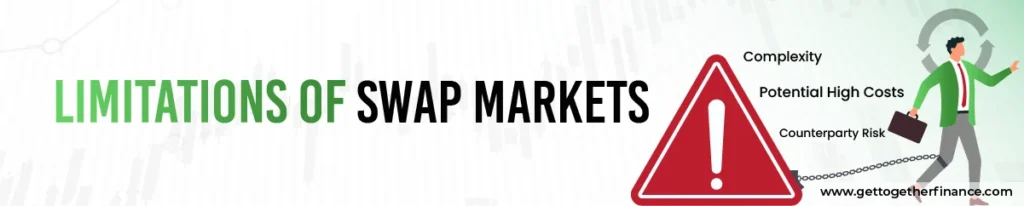
Even though swap offers advantages, it also comes with certain limitations, which include:
- Complexity
Swap agreements are complicated and require a good understanding to handle them.
- Potential High Costs
Creating and managing a customized swap agreement can involve additional administrative costs and transaction charges.
- Counterparty Risk
When a party is not able to pay its obligation, then this is called counterparty risk.
- Limited Transparency
Swap transactions are tarded privately, which creates two problems: limited market information and price transparency.
- Liquidity Risk
Some swap agreements are hard to cancel early because searching for a replacement party is problematic.
- Regulatory Challenges
New regulations can affect the swap market. They impact how swap agreements are made and used.
Role of Swap Markets in Financial Stability
Generally, risk leads to an unstable market. Here’s how swap markets help in bringing financial stability:
- Liquidity: By enabling risk transfer, swaps help regulate market liquidity.
- Efficient Pricing: Swaps contribute to more efficient pricing of risk and financial instruments.
- Risk management: Swaps are primarily used as risk management tools to reduce potential financial distress.
Challenges and Risks in Swap Markets
While swap markets are efficient and have numerous benefits, they also face many challenges:
- Counterparty Risk: As no regulator or exchange controls swaps, counterparty default risk is always there.
- Regulatory Risk: Changes in rules and regulations can adversely impact the swap market.
- Liquidity Risk: In stressed markets, finding counterparties is difficult.
Swaps also played a huge role in the 2008 financial crisis that resulted in global distress.
Conclusion
Swap markets give parties the option to manage risks, speculate, arbitrage, etc. Understanding and using swaps can provide many advantages. However, swaps carry many risks, like counterparty and liquidity risks. Investors need to tread wisely to benefit from swap markets.
FAQs
What do you mean by swap market?
Swap markets enable the exchange of cash flows associated with assets or liabilities between counterparties. Swaps can help manage interest rates, currencies, commodities, and credit risk.
What is a swap with an example?
A and B take a loan of ₹ 1 lakh each. While A takes a loan for a fixed rate of 8% p.a., B takes a floating rate loan at EBLR + 1%. They swap the interest rates, feeling that the other option is better. Assuming EBLR is 6%, A will receive ₹ 1,000 from B after 1 year as compensation against this contract. Hence, the credit risk of A is protected by swap in this case.
What is the full form of the swap?
Although the full form of SWAP is Simultaneous Withdrawal & Deposit, it is popularly called a swap in the financial world.
What are the types of swaps?
There can be many types of swaps depending on the parties’ needs. However, the most popular ones are:
Interest Rate Swap (IRS)
Currency Swaps
Equity Swaps
Credit Default Swap (CDS)
Commodity Swap