
Best Options Trading Strategies in India (2026): Choose by Market View & Risk
- Updated on :
- 9635 Views
- by Arun Singh Tanwar

 Facebook
 Instagram
 Youtube
 Linkedin

Options strategies can work differently depending on which way the market is moving. In an uptrend, traders may look at bullish strategies, while a downtrend may call for bearish strategies. A sideways market usually needs a different approach, since the price stays within a range and direction-based trades become less useful. In this blog, we’ll look at different options strategies for bullish, bearish, and sideways markets, and see how their risk and payoff can vary.
Best Options Strategies for Beginners: Start With Defined Risk
For beginners, defined-risk strategies are easy to understand because they know how much risk they incur before entering a trade. A few examples are Bull Call Spread, Bull Put Spread, Bear Put Spread, Bear Call Spread, Iron Condor, and Iron Butterfly. But defined risk doesn’t mean there’s no risk. That’s why beginners should first understand the setup, maximum loss, breakeven, and possible payoff before using any strategy.
Risk Management: Defined-Risk vs. Undefined-Risk Options Strategies
You might have come here after reading how risky options trading is and it has full potential to empty your accounts. Options trading involves real risk, and different strategies behave differently as market conditions change. Traders can study these strategies based on their market outlook, payoff structure, risk level, implied volatility, and time to expiry. No strategy guarantees profits, and losses can happen if the price moves against the position or conditions shift. Different market conditions, such as bullish, bearish, or sideways markets, may suit different options strategies.
It is misleading to say any options strategy is “safe.” Iron Condor and Iron Butterfly limit how much you can lose, but naked short straddles and strangles can result in very large, even theoretically unlimited, losses. Even defined-risk strategies can lose money, up to a set limit. So it’s important for traders to understand how the payoff works before entering. However, even defined-risk strategies can be affected by sharp price moves, volatility changes, and market gaps.
Educational Note: This article is meant for learning purposes only and shouldn’t be taken as financial or trading advice. Options trading carries real risk, and the strategies covered here can lead to losses. So, before making any trading decision, readers should understand a strategy’s payoff, risks, and the market conditions it depends on.
Bullish Options Strategies: Compare Bull Call Spread, Bull Put Spread & Alternatives
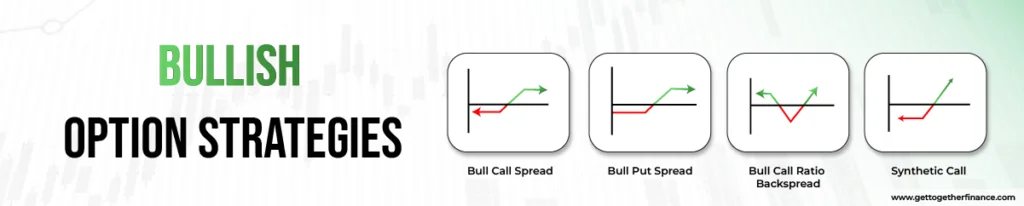
Each strategy has its own market view, setup, risk level, and how much it’s affected by time decay. Below, we explain the key factors of each strategy so you can understand how they work.
Bull Call Spread
- Market View: Moderately bullish.
- Setup: Buy a call option at a lower strike price and sell another call option at a higher strike price, both with the same expiry date.
- Max Profit: The most you can earn from this trade is the gap between the two strike prices, minus what you paid to enter it.
- Max Loss: The most you can lose is the premium you paid.
- Breakeven: Lower strike price + net premium paid.
- IV/Theta Sensitivity: Rising implied volatility can help the position, while time decay usually works against it, since the call you bought loses time value.
- Key Risk: The profit on the upside is limited, and you could lose the premium you paid if the price doesn’t rise enough.
- Example: Let’s say a trader buys a ₹100 call for ₹8 and sells a ₹120 call for ₹3. This means the net cost is ₹5. The maximum they can lose is ₹5, and the maximum they can earn is ₹15.
Bull Put Spread
- Market View: Moderately bullish or neutral-to-bullish.
Setup: Sell a put option at a higher strike price, and buy another put option at a lower strike price, both with the same expiry date.
Max Profit: Limited to the net premium received.
Max Loss: It’s limited to the difference between the two strike prices, minus the premium you received.
Breakeven: Higher strike price − net premium received.’ - IV/Theta Sensitivity: Since this is a net premium-selling strategy, falling volatility and time decay both work in the trader’s favour here, rather than against them.
- Key Risk: The profit is limited on the upside, and you could lose the premium you paid if the price doesn’t go up enough.
- Example: Let’s say a trader sells a ₹100 put for ₹7 and buys a ₹90 put for ₹3. This gives a net premium received of ₹4. The most they can earn is ₹4, the most they can lose is ₹6, and the breakeven point is ₹96.
Bull Call Ratio Backspread
- Market View: Strongly bullish, especially when a significant upward move is expected.
Setup: Sell one call at a lower strike, and buy two or more calls at a higher strike, all with the same expiry date, depending on the structure. - Max Profit: Potentially unlimited on a strong upward move because the long calls can continue gaining value.
- Max Loss: It depends on the strike prices and net premium. The biggest loss usually happens near the strike price of the calls you bought.
- Breakeven: It depends on the strike prices and whether you enter the strategy at a net cost (debit) or receive money upfront (credit)
- IV/Theta Sensitivity: Higher implied volatility benefits the bought calls, while time decay hurts the position, especially if the price doesn’t move as expected.
- Key Risk: The position can lose money if the price stays close to the long-call strike at expiry.
- Example: Let’s say a trader sells one ₹100 call and buys two ₹110 calls, all with the same expiry. If the stock rises sharply above ₹110, the two calls the trader bought can gain value faster than the one they sold.
Synthetic Call
- Market View: Bullish.
- Setup: Buy the underlying asset, and also buy a put option on it, usually with the same strike price and expiry.
- Max Profit: Potentially unlimited as the underlying price rises.
- Max Loss: The loss is limited when the put protects the position. If the put’s strike is close to the stock’s purchase price, the loss can be close to just the premium paid for the put.
- Breakeven: Approximately the stock purchase price + put premium, ignoring other costs.
- IV/Theta Sensitivity: The put option benefits from rising implied volatility, but it also loses time value as expiry gets closer. The stock position itself isn’t directly affected by time decay (theta).
- Key Risk: This strategy still carries stock-market risk, and buying the put reduces your potential gains.
- Example: Suppose a trader buys a stock at ₹100 and buys a ₹100 put for ₹4. The put protects them if the price drops below ₹100, while they still gain if the stock goes up.
Bearish Options Strategies: Compare Bear Put Spread, Bear Call Spread & Alternatives
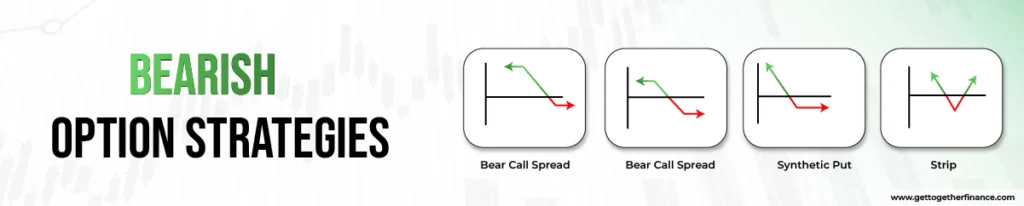
Each strategy has its own setup, risk level, and how it reacts to implied volatility and time decay. Below, we compare the key features of each strategy using the same format.
Bear Call Spread
- Market View: Moderately bearish to neutral.
- Setup: Sell a call option at a lower strike price, and buy another call option at a higher strike price, both with the same expiry date.
- Max Profit: Limited to the net premium received.
- Max Loss: Limited to the difference between the two strike prices minus the net premium received.
- Breakeven: Lower strike price + net premium received.
- IV/Theta Sensitivity: A drop in implied volatility, along with time decay, usually helps this strategy.
- Key Risk: If the price rises sharply, it can lead to the strategy’s maximum defined loss.
- Example: Let’s say a trader sells a ₹105 call for ₹6 and buys a ₹110 call for ₹3. This means the net premium received is ₹3. The most they can earn is ₹3, and the most they can lose is ₹2.
Bear Put Spread
- Market View: Moderately bearish.
- Setup: Buy a put option at a higher strike price, and sell another put option at a lower strike price, both with the same expiry date.
- Max Profit: It’s limited to the gap between the two strike prices, minus what you paid in premium.
- Max Loss: Limited to the net premium paid.
- Breakeven: Higher strike price − net premium paid.
- IV/Theta Sensitivity: A rise in implied volatility can benefit this strategy, but time decay usually works against it.
- Key Risk: The price may not fall enough to make up for the premium paid.
- Example: Let’s say a trader buys a ₹105 put for ₹7 and sells a ₹95 put for ₹3. This means the net premium paid is ₹4. The most they can earn is ₹6, and the most they can lose is ₹4.
Strip
- Market View: Mainly bearish, though it can also gain if the price moves either way sharply.
- Setup: Buy one call and two puts, all with the same strike price and expiry.
- Max Profit: Can gain a lot if there’s a big price move, especially on the downside, since the strategy includes two puts.
- Max Loss: Limited to the total premium paid.
- Breakeven: There can be two breakeven points, one higher and one lower, depending on the premiums paid and the strike price.
- IV/Theta Sensitivity: Higher implied volatility can benefit the long options, but time decay usually lowers their value.
- Key Risk: The full premium can be lost if the price stays near the strike price all the way to expiry.
- Example: Let’s say a trader buys one ₹100 call for ₹4, and two ₹100 puts at ₹3 each. This adds up to a total premium of ₹10. The maximum they can lose is ₹10.
Synthetic Put
- Market View: Bearish.
- Setup: The trader is betting that the price will fall by shorting the asset, but also buys a call option as insurance in case the price rises instead; this limits how much they can lose.
- Max Profit: Profit can be large if the price falls sharply, but it’s capped since the price can’t fall below zero.
- Max Loss: The maximum loss is limited by the call option, based on the strike price and premium paid.
- Breakeven: Take the price at which you shorted the stock and subtract the premium you paid for the call option.
- IV/Theta Sensitivity: Higher implied volatility can benefit the call, but time decay usually works against it.
- Key Risk: The short position loses value if the price goes up, but the call option caps the risk once the price crosses its strike.
- Example: Let’s say a trader shorts a stock at ₹100 and buys a ₹100 call for ₹4. If the stock rises above ₹100, the maximum they can lose by expiry is the ₹4 premium, not counting other costs.
Neutral & Range-Bound Options Strategies: Iron Condor, Straddle, Strangle & Butterfly
Depending on the strategy, traders may expect either low volatility with a range-bound market or a sharp move in either direction. These strategies differ in their risk, reward, and how much they’re affected by changes in implied volatility.
Here are some defined-risk neutral strategies given:
Long Straddle
A long straddle is an options trading strategy where an investor simultaneously purchases a call option and a put option with the same strike price and expiration date for the same underlying asset. This strategy is used when the investor expects a substantial move in either direction but is uncertain about the direction.
- Risk: Limited to the total premium paid.
- Reward: Can be large if the price makes a strong move.
- IV: Rising implied volatility usually helps the position, while falling IV can lower the value of the options.
- Time Decay: It generally works against the position.
Long Strangle
A long strangle is an options strategy in which a trader buys an out-of-the-money (OTM) call option and an OTM put option on the same underlying asset. Both options have the same expiry date but different strike prices. This strategy is employed when the investor anticipates a substantial move but is uncertain about whether it will be upward or downward.
- Risk: Limited to the total premium paid.
- Reward: Can be large if the price makes a strong move.
- IV: Rising IV can help the value of the options you bought, while falling IV can work against the position.
- Time Decay: It generally lowers the value of the options.
Iron Condor
An Iron Condor combines a Bull Put Spread and a Bear Call Spread. It’s usually used when the trader expects the price to stay within a certain range.
- Risk: It’s capped at the gap between the outer strike prices, minus the premium received.
- Reward: Limited to the net premium received.
- IV: Falling IV can generally help the position.
- Time Decay: It generally works in favour of the position.
Iron Butterfly
An Iron Butterfly is a defined-risk strategy that combines a short straddle with a protective call and put option for safety. It’s typically used when the trader expects the price to stay near the middle strike.
- Risk: It’s limited to the spread’s width, minus the premium received.
- Reward: Limited to the net premium received.
- IV: Falling IV can generally help the position.
- Time Decay: It generally works in favour of the position.
Here are some undefined-risk neutral strategies given:
Short Straddle
A short straddle is an options trading strategy. In it, an investor sells both a call option and a put option, using the same strike price and expiration date, on the same underlying asset. It’s usually used when the trader expects the price to stay fairly stable.
- Risk: Can be unlimited, since a sharp move in either direction can lead to large losses.
- Reward: Limited to the total premium received.
- IV: Falling IV usually helps the position, while rising IV can push up the value of the options that were sold.
- Time Decay: It usually works in favour of the position.
Short Strangle
A short strangle is an options trading strategy. In it, an investor sells an out-of-the-money (OTM) call option and an out-of-the-money put option on the same underlying asset, with both options sharing the same expiration date.
- Risk: Can be unlimited if the price makes a sharp move in either direction.
- Reward: Limited to the total premium received.
- IV: Falling IV usually helps the position, while rising IV can raise the risk of the options sold.
- Time Decay: It usually works in favour of the position
How Implied Volatility and Theta Change Strategy Selection
Implied volatility (IV), time decay, and days to expiry can affect how an options strategy works. That’s why traders should also take into account the expected market move, upcoming events, and the level of risk involved.
- IV Level: High IV can make option premiums more expensive, while low IV can make them cheaper. But IV alone shouldn’t be the deciding factor for the strategy.
- IV Crush: After a major event, IV can fall fast, and that can bring option premiums down.
- Theta Decay: Theta reflects how an option loses value over time. It usually hurts buyers, while it can work in favour of sellers.
- Days to Expiry: As expiry gets closer, time decay usually picks up speed. So traders should think about whether there’s enough time left for the price to move the way they expect before expiry.
Options Strategy Comparison Table: View, Risk, Reward, IV & Complexity
There are various types of options strategies that suit different market conditions and levels of risk. In order to make these differences easier to understand, the table below compares each strategy based on its market view, risk, reward, IV effect, and complexity.
| Strategy | Market View | Risk | Reward | IV Effect | Complexity |
| Bull Call Spread | Moderately bullish | Defined | Limited | Rising IV can help | Medium |
| Bull Put Spread | Bullish to neutral | Defined | Limited | Falling IV can help | Medium |
| Bull Call Ratio Backspread | Strongly bullish | Depends on setup | Potentially large | Rising IV can help | High |
| Synthetic Call | Bullish | Defined by put protection | Potentially large | Falling IV can help | Medium |
| Bear Call Spread | Moderately bearish to neutral | Defined | Limited | Falling IV can help | Medium |
| Bear Put Spread | Moderate bullish | Defined | Limited | Rising IV can help | Medium |
| Strip | Bearish with large-move expectation | Limited | Potentially large | Rising IV can help | High |
| Synthetic Put | Bearish | Limited by call protection | Large if price falls | Rising IV can help the call | Medium |
| Long Straddle | Large move in either direction | Limited to premium paid | Potentially large | Rising IV can help | Medium |
| Long Strangle | Large move in either direction | Limited to premium paid | Potentially large | Rising IV can help | Medium |
| Short Straddle | Range-bound | Very high / theoretically unlimited | Limited to premium received | Falling IV can help | High |
| Short Strangle | Range-bound | Very high / theoretically unlimited | Limited to premium received | Falling IV can help | High |
| Iron Condor | Range-bound | Defined | Limited | IV changes can affect the position | High |
| Iron Butterfly | Range-bound | Defined | Limited | IV changes can affect the position | High |
Options Strategies for High-Volatility Markets
In a high-volatility market, prices can move fast and sharply, in either direction. Long Straddle and Long Strangle are two strategies traders may look at when they expect a strong price move but aren’t sure which way it will go. Both strategies involve buying options, so the most you can lose is the premium paid.
However, high volatility can also push up option prices, making these strategies more expensive to enter. Before choosing a strategy, traders should also consider implied volatility, time decay, and days to expiry. Since no strategy guarantees profits, the final result depends on how the price moves after the trade is entered.
Worked Example: Compare Two Strategies on the Same NIFTY View
Let’s say a trader expects NIFTY to rise moderately and is comparing a Bull Call Spread with a Bull Put Spread. Both strategies take a bullish view, but their risk, reward, and breakeven levels can differ. The table below shows how they compare.
| Detail | Bull Call Spread | Bull Put Spread |
| Example Setup | Buy 25,000 Call at ₹200 and sell 25,500 Call at ₹80 | Sell 24,500 Put at ₹150 and buy 24,000 Put at ₹70 |
| Net Position | ₹120 debit | ₹80 credit |
| Max Profit | ₹380 | ₹80 |
| Max Loss | ₹120 | ₹420 |
| Breakeven | 25,120 | 24,420 |
Conclusion
How an options strategy performs depends on different factors, such as market view, risk level, implied volatility, and time left to expiry. Some strategies suit a bullish or bearish outlook, while others work better when the market is expected to stay range-bound or make a sharp move. For beginners, it’s important to understand the setup, maximum loss, breakeven point, and possible payoff before using any strategy. Defined-risk strategies make it easier to know your potential loss upfront, but they still carry risk.
There is no single strategy for every market condition. That’s why traders need to understand how each strategy works and the risks involved to make more informed decisions.
FAQ‘s
Which Options Strategy Has Defined Risk?
Strategies like Bull Call Spread, Bear Put Spread, Iron Condor, and Iron Butterfly have a fixed maximum loss when built as spreads. This maximum loss depends on the strike prices and the premium paid or received.
Which Options Strategy Is Used for Sideways Markets?
Strategies like Iron Condor, Iron Butterfly, Short Straddle, and Short Strangle can be used when traders expect the price to move very little. But short straddles and strangles can carry very large, or even theoretically unlimited, risk.
How Does Implied Volatility Affect Options Strategy Choice?
High implied volatility can push option premiums up, while low IV can make them cheaper. Before choosing a strategy, traders should also think about the expected price move, event risk, time left until expiry, and the risk level of the strategy.
What Should Beginners Learn Before Trading Options?
Beginners should first learn stock market basics, options terms, payoff structures, risk management, and implied volatility. By understanding how different strategies work before trading with real money, traders can build a stronger foundation.
What Changes Near Options Expiry?
As expiry gets closer, time decay usually speeds up. This can change how much options are worth, so traders should keep in mind the time left and the expected price move.